11 December 2025
The Essential Guide to Your Brain After 40: The Neuroscience of Perimenopause

Reading time 10 min

Reading time 10 min
You forget the word for “spreadsheet” in front of the executive committee. You walk into a meeting having lost the thread of why you came. The neuroscience of perimenopause describes a real, measurable shift in how your brain runs, and it starts years before your menstrual periods stop. Estrogen receptors are found across the regions that handle memory, executive function, temperature regulation, and emotion. When estradiol begins to fluctuate, every one of those regions reacts to the change. The brain changes most affected in perimenopause, partially recover in postmenopause, and are shaped along the way by sleep, vasomotor symptoms, and cognitive load.
Estrogen receptors are organized in dense networks across four brain regions that matter for everything you do at work:
The same hormone that drives your reproductive cycle is also a working part of the cognitive machinery you rely on in meetings, in negotiations, and in any room where you need to think clearly under pressure.
A receptor is the part of a cell that recognizes a specific chemical signal. Picture a lock shaped to open with one particular key, where the key is the hormone. When estrogen arrives at a cell with estrogen receptors, it binds and triggers a chain of changes inside the cell: which genes get switched on, how the cell uses energy, and how it talks to its neighbors. Cells without estrogen receptors do not respond to estradiol, which is why receptor distribution determines where the hormone actually works in the brain.
Estrogen receptors are not concentrated only in those four regions. They are located throughout the central nervous system, including the broader cortex, brainstem, cerebellum, basal ganglia, spinal cord, and the microglia (the immune cells of the brain).2 When estrogen starts to fluctuate in perimenopause, every region with estrogen receptors responds to the change.
Inside the brain, estradiol (the most abundant and potent type of estrogen) does a lot of work. It supports the formation of new connections between neurons (aka synapses), helps regulate brain blood flow, influences how brain cells take up and use glucose for fuel, and shapes the activity of neurotransmitters like acetylcholine and serotonin that govern attention and mood.1,3 When estradiol levels start changing in perimenopause, the brain responds by reorganizing.
The signature of perimenopause is variability rather than simple decline. Estrogen rises, crashes, rises again, and the brain has to recalibrate at every turn. PET imaging in midlife women shows that brain estrogen receptor density rises across the menopause transition, in the same regions where memory complaints localize.⁴ Higher receptor density correlates with poorer memory performance and predicts mood and cognitive symptoms after menopause.⁴ The interpretation is that the brain is upregulating receptors in response to falling and fluctuating estradiol, trying to adapt to a less reliable signal.
Imaging studies across the menopause transition show changes in four dimensions of the brain. The framework comes from Mosconi’s multimodal imaging work.
Metabolism. Estrogen regulates how brain cells take up and use glucose, and as estrogen fluctuates, glucose use in memory-relevant regions starts to falter. Imaging in clinically and cognitively normal women shows reduced glucose uptake in perimenopause, tied to a parallel decline in mitochondrial efficiency.5 The brain is the most energy-hungry organ in the body, so the tasks you notice slipping first are the ones that demand the most energy: sustained attention, word retrieval, and working memory.
Structure. Gray matter volume in regions central to memory and executive function changes measurably across the transition. The trajectory in Mosconi’s 2021 imaging cohort shows gray matter dropping through perimenopause and recovering, partially or fully, in postmenopause for most women.12 White matter shows a similar change pattern.
Curious Fact: During perimenopause, women’s brain structure temporarily shifts to look more like a man’s. However, both before and after this transition, women actually have denser and more organized white matter than men do.13
Function. Functional MRI during memory tasks shows that hippocampal activity in midlife women varies by reproductive stage independently of age. Lower estrogen levels are linked to reduced activity in the hippocampus, which directly compromises the brain’s ability to successfully retrieve memories.7 Estrogen acts as a stabilizer for the body’s internal thermostat. In its absence, a specific group of hypothalamic cells called KNDy neurons lose their ‘brake’ and are active erratically. This erratic signaling tricks the brain into sensing an emergency heat spike, triggering hot flashes and night sweats to cool the body down.6 There is a significant cognitive cost to interrupted rest: night sweats fragment the sleep architecture, impairing the brain’s ability to consolidate new memories, which leads to a functional decline in daytime memory and focus.
Connectivity. Brain scans during the menopausal transition reveal a fundamental “rewiring” of the networks responsible for memory and executive function. According to Mosconi’s research, this isn’t an isolated event; the brain’s physical structure and its energy metabolism shift at the same time, which drives the fluctuations in cognitive performance that women experience during this period.12 In a study on memory for specific events, postmenopausal women who performed the best had brain connectivity patterns similar to those of younger, premenopausal women. This indicates that for some, the way the brain reorganizes itself during the transition can actually protect and maintain mental sharpness.7
Long-term studies like SWAN and RICAM have followed large groups of women to get a clear picture of how the brain changes during menopause transition. Their most consistent finding is that perimenopause brings a measurable but contained decline in mental sharpness, specifically showing a modest decline in verbal memory (finding your words) and processing speed (how fast you think on your feet). While you might feel a bit more scattered, the impact on your attention and working memory is generally much smaller when measured objectively. The science confirms that while your mental “quickness” may change, the core of your cognitive function remains remarkably stable.8,9 While these changes are real, they aren’t catastrophic for most women. Research shows that only about one in five women falls into a specific vulnerability category. For this group, the transition is more noticeable, typically showing up as a clear struggle with verbal learning paired with poor sleep. For everyone else, the change is much more subtle.10
The other four out of five women stay within the normal range, though their specific mental strengths and weaknesses vary. Instead of being tied to your age, these cognitive changes in memory and word retrieval are driven by factors like sleep, mood, stress, and the intensity of your hot flashes.9,10 Finally, the cognitive change is most noticeable in the first year after the final menstrual period, and most women improve thereafter.11
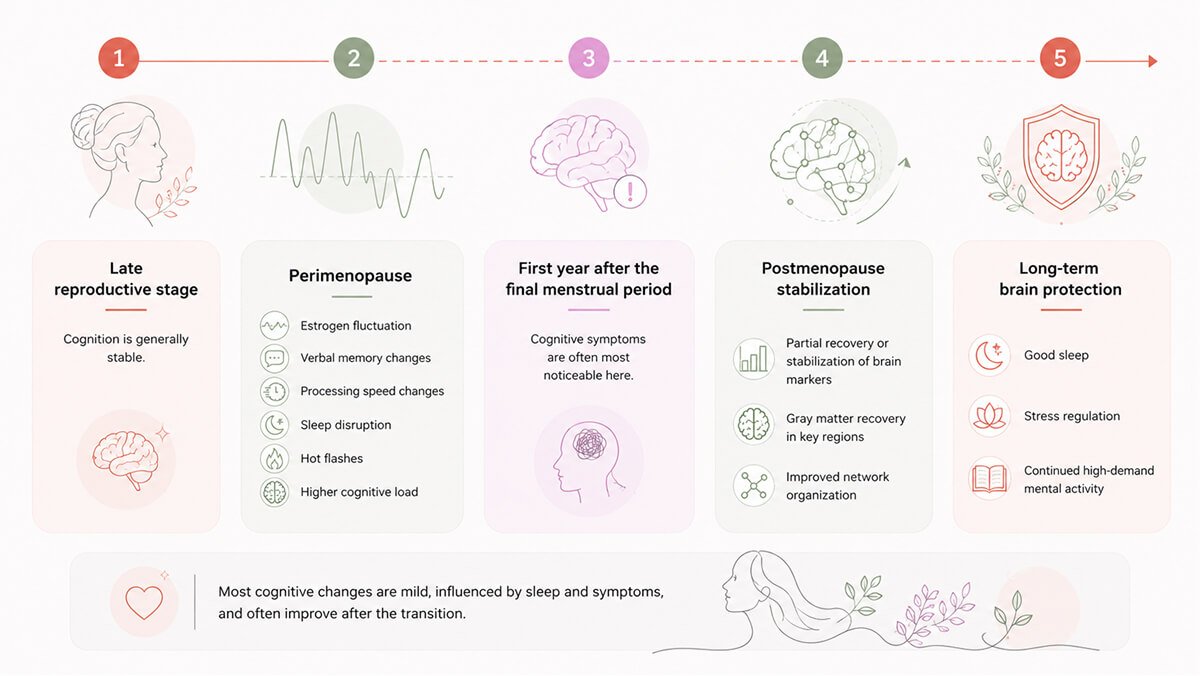
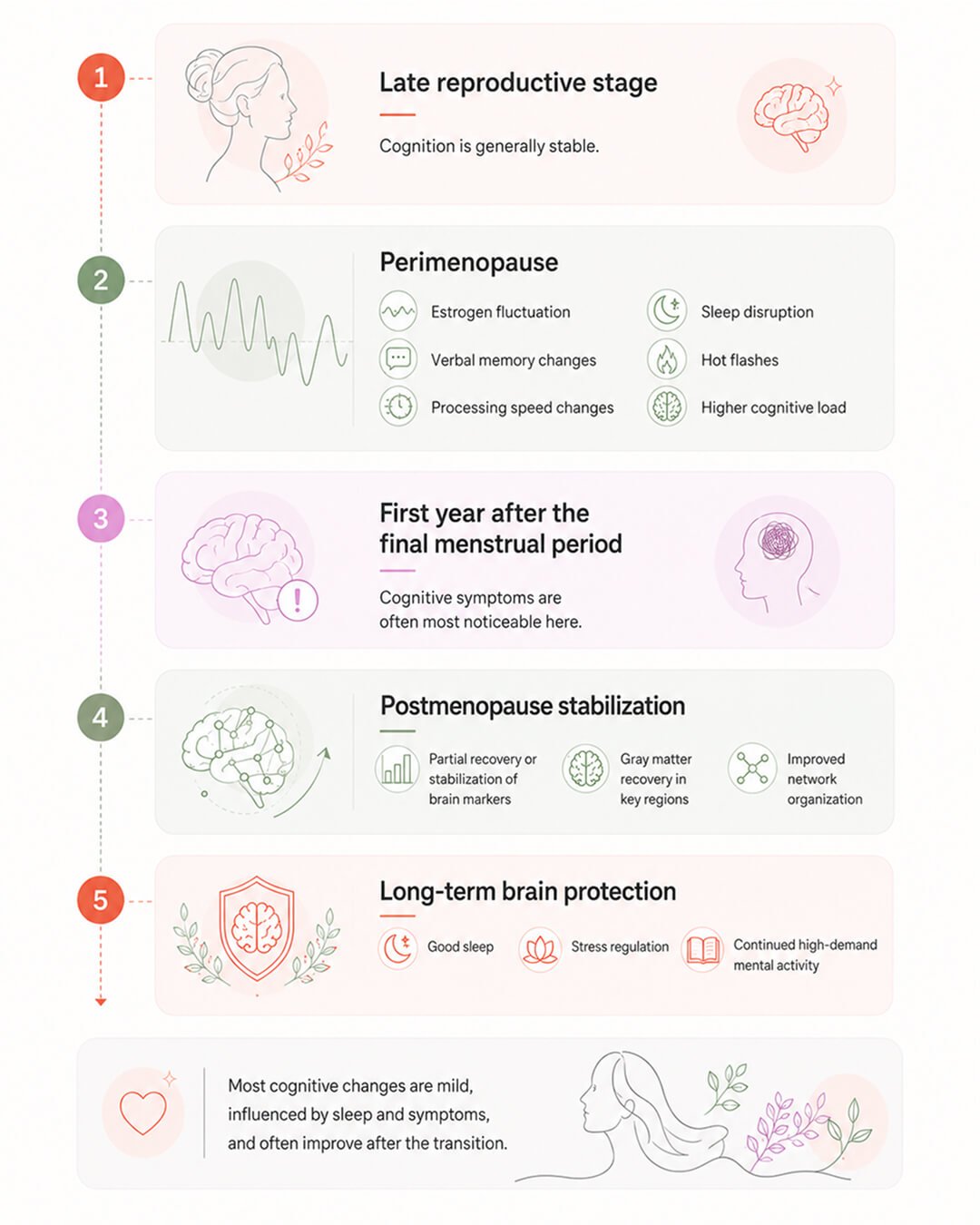
Curious Fact. The most striking finding of recent imaging research is the recovery. Imaging across the menopause transition shows that most brain markers stabilize after menopause, gray matter volume recovers in regions important for cognition, and the recovery correlates with cognitive performance.12
This is where career stakes meet biology. Data shows that for most adults, literacy and numeracy skills actually improve into their forties. While these skills eventually decline, that usually only happens to people who aren’t using them regularly. In fact, highly educated professionals who use their skills daily see them continue to rise well past their 40s.14
For those of us in perimenopause, the takeaway is practical. Engaging in high-demand mental work helps keep your skills sharp or even improving past 40, while low-demand mental work leads to an earlier decline. It is tempting to pull back when brain fog or fatigue makes complex tasks feel harder, but doing so removes the exact mental stimulation that protects your brain. This makes both sleep and staying mentally active vital. Staying engaged provides the “load” your brain needs to navigate this reorganization.
The neuroscience of perimenopause shows a brain undergoing a transition that most women eventually recover from. How you view this phase determines your next move. If you see the “decline” as permanent, you might pull back from demanding work, but that withdrawal is exactly what accelerates actual loss. If you see it as a temporary transition and keep your mental demand high, you provide the protection your brain needs. We now understand this well enough to make better choices, and the habits we set during these years shape our future.
If you see it as a temporary transition and keep your mental demand high, you provide the protection your brain needs. We now understand this well enough to make better choices, and the habits we set during these years shape our future.
Dr. Jūra Lašas
1.
Hara, Y. et al. Estrogen Effects on Cognitive and Synaptic Health Over the Lifecourse (2015). https://doi.org/10.1152/physrev.00036.2014
2.
Acosta-Martínez, M. Shaping Microglial Phenotypes Through Estrogen Receptors: Relevance to Sex-Specific Neuroinflammatory Responses to Brain Injury and Disease (2020). https://doi.org/10.1124/jpet.119.264598
3.
Hogervorst, E. et al. Cognition and mental health in menopause: A review (2021). https://doi.org/10.1016/j.bpobgyn.2021.10.009
4.
Mosconi, L. et al. In vivo brain estrogen receptor density by neuroendocrine aging and relationships with cognition and symptomatology (2024). https://doi.org/10.1038/s41598-024-62820-7
5.
Mosconi, L. et al. Perimenopause and emergence of an Alzheimer’s bioenergetic phenotype in brain and periphery (2017). https://doi.org/10.1371/journal.pone.0185926
6.
Gombert-Labedens, M. et al. Effects of menopause on temperature regulation. (2025). https://doi.org/10.1080/23328940.2025.2484499
7.
Jacobs, E. et al. Impact of Sex and Menopausal Status on Episodic Memory Circuitry in Early Midlife (2016). https://doi.org/10.1523/jneurosci.0951-16.2016
8.
Karlamangla, A. et al. Evidence for Cognitive Aging in Midlife Women: Study of Women’s Health Across the Nation (2017). https://doi.org/10.1371/journal.pone.0169008
9.
Metcalf, C. A. et al. Cognitive Problems in Perimenopause: A Review of Recent Evidence (2023). https://doi.org/10.1007/s11920-023-01447-3
10.
Weber, M. et al. Cognitive profiles in perimenopause: hormonal and menopausal symptom correlates (2021). https://doi.org/10.1080/13697137.2021.1892626
11.
Weber, M. T. et al. Cognition in perimenopause: the effect of transition stage (2013). https://doi.org/10.1097/gme.0b013e31827655e5
12.
Mosconi, L. et al. Menopause impacts human brain structure, connectivity, energy metabolism, and amyloid-beta deposition (2021). https://doi.org/10.1038/s41598-021-90084-y
13.
Raikes, A. et al. White matter microstructural and macrostructural profiles during midlife reveal sex differences between men and women at different menopausal stages (2025). https://doi.org/10.1038/s41598-025-24136-y
14.
Hanushek, E. et al. Age and cognitive skills: Use it or lose it (2024). https://doi.org/10.1126/sciadv.ads1560

Mood & Energy Solutions

Fatigue Causes & Types

Fatigue Causes & Types

Workplace Strategies

Menopause at Work

Brain Fog at Work

Brain Fog at Work

Is This Perimenopause?

Is This Perimenopause?

Nutrition & Supplements

Workplace Strategies

Menopause Science

Menopause Science

Brain Fog Solutions

We use cookies and similar technologies to ensure the proper functioning of our website, personalize content, provide social media features, and analyze traffic. By clicking “I Agree”, you consent to the use of these technologies.
No results