25 December 2025
Science Digest: Exercise and Time-Restricted Eating

Reading time 7 min
Reading time 7 min
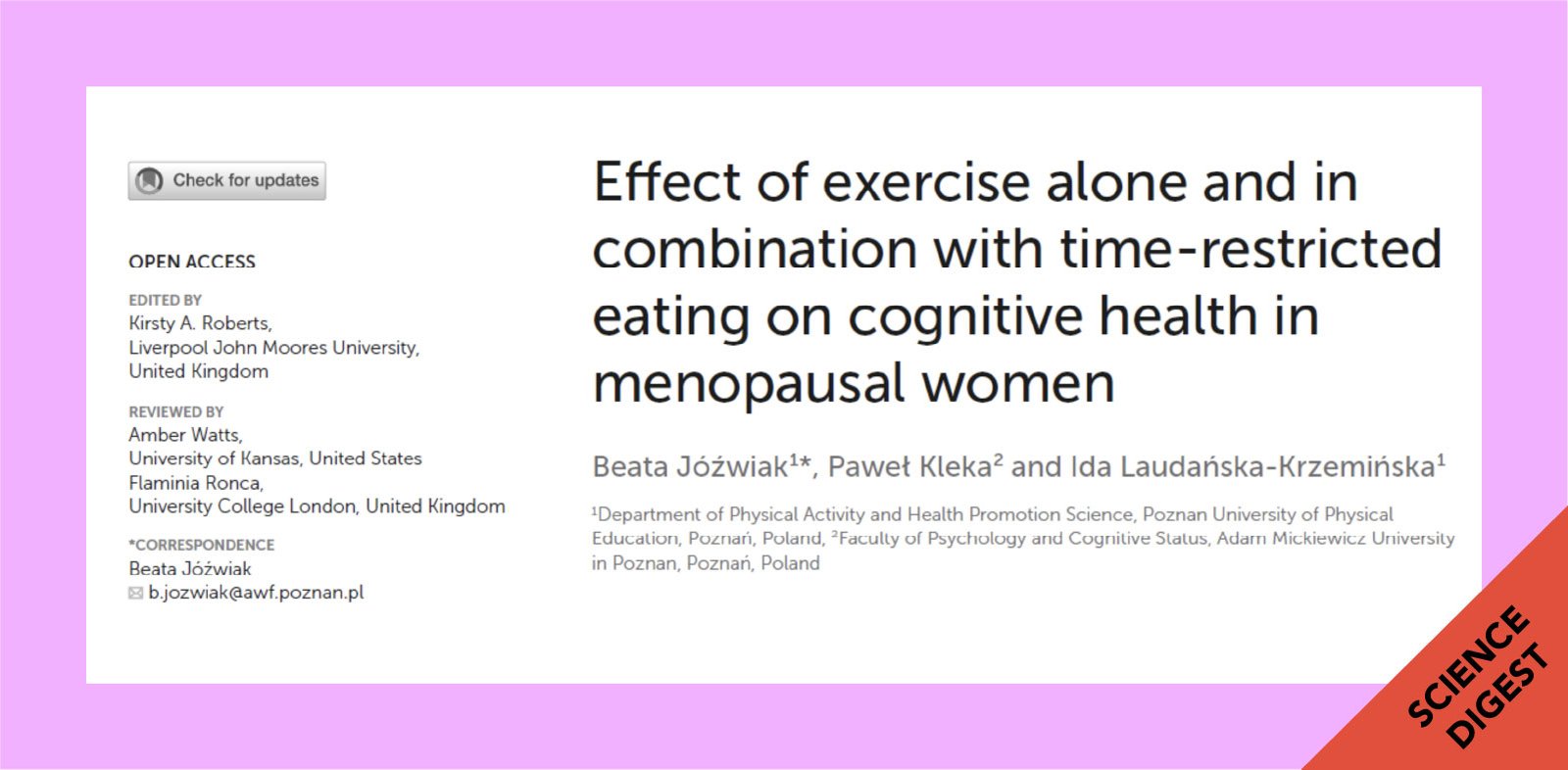
This week’s paper, “Effect of exercise alone and in combination with time-restricted eating on cognitive health in menopausal women”, was published August 2025 in Frontiers in Public Health, a respected (Q1), peer-reviewed journal in public health research.
I chose this study because intermittent fasting (especially the 16:8 pattern) is one of the most popular wellness trends of the decade – and many midlife women have adopted it in hopes of boosting metabolism, energy, and focus. But does pairing it with exercise actually improve brain health during menopause? This research team put that exact question to the test.
Researchers from two universities in Poland ran a 12-week intervention in 59 perimenopausal, menopausal, and postmenopausal women, comparing two groups:
Before and after the intervention, participants completed cognitive tests (measuring processing speed, selective attention, working memory and attention), EEG brain activity recordings, and blood tests for proteins linked to learning and memory: BDNF (brain-derived neurotrophic factor) and GDNF (glial cell line-derived neurotrophic factor).
In short: exercise worked, fasting didn’t add much.
The trial was small, lasted just 12 weeks, menopausal status was self-reported, and it lacked a control group that did neither exercise nor fasting. We can’t fully separate true intervention effects from practice improvements on tests. The study ran during the COVID-19 pandemic, which may have affected stress levels and adherence.
The researchers didn’t set a fixed time for when women had to start their 8-hour eating window, so everyone followed their own schedule. They also didn’t follow the plan perfectly – on average, women kept to the eating window about 62% of the time. The study didn’t track how many calories they ate, so it’s unclear whether any changes came from meal timing or simply from eating less.
This study reinforces what decades of neuroscience have shown: exercise is one of the most powerful tools we have to protect the brain. While both intermittent fasting and exercise have independently shown health benefits, combining them didn’t produce superior cognitive outcomes.
Research on intermittent fasting in people shows mixed results. Some animal studies suggest fasting helps the brain repair itself and clean out damaged cells, but studies in women don’t always show the same thing.
The fact that BDNF levels didn’t change goes against some earlier studies, but it fits with research showing that women’s brains may react differently than men’s to exercise. Short periods of fasting might lower stress or inflammation, but when combined with exercise, it could sometimes make the body and mind feel more strained instead of stronger.
If you’re experiencing cognitive symptoms, such as brain fog, memory issues, or difficulty concentrating, regular exercise can be a reliable strategy for cognitive support. You don’t need to add time-restricted eating to see benefits.
The exercise protocol used in this study was moderate-intensity circuit training combining strength and cardio, done twice weekly for 55 minutes per session. This isn’t extreme, it’s achievable for most women. The key was consistency over 12 weeks, with participants attending over 96% of sessions.
If you’re already practicing intermittent fasting and enjoying it, this study doesn’t suggest you should stop. However, if you’re considering adding time-restricted eating specifically for cognitive benefits while also starting an exercise program, these findings suggest you might want to focus on getting the exercise habit established first.
This paper reminds me of a core truth in health: the simplest habits often do the most good. You don’t need to chase complex biohacks to sharpen your mind, just move your body!
Exercise isn’t merely about muscles or metabolism; it’s a direct investment in your brain’s health.
The data here suggest that adding fasting doesn’t enhance those effects and may even blunt them for some women.
So, lace up your shoes, lift some weights, take that brisk walk. Your neurons will thank you.
Dr. Jūra Lašas
1.
Jóźwiak, B. et al. Effect of exercise alone and in combination with time-restricted eating on cognitive health in menopausal women. (2025) https://doi.org/10.3389/fpubh.2025.1640512
Eat to Thrive

Healthy Body & Mind
Brain & Mind Wellness

Treatments & Supplements
Eat to Thrive

Understanding Menopause
Scientific Research

Understanding Menopause

Eat to Thrive

Lifestyle & Self-Care
Scientific Research

Exercise & Nutrition

Eat to Thrive

Symptoms Explained

Eat to Thrive
Eat to Thrive

Scientific Research
Treatments & Supplements

We use cookies and similar technologies to ensure the proper functioning of our website, personalize content, provide social media features, and analyze traffic. By clicking “I Agree”, you consent to the use of these technologies.
No results