25 November 2025
Decode Your Menopause Transition: Download the Questionnaire Set

Reading time 7 min

Reading time 7 min
Every woman’s menopause journey looks different. Some sail through with mild symptoms, while others feel like they’ve been destroyed. So how can you tell where you are in the transition, and whether your symptoms are mild, moderate, or severe?
That’s where questionnaires come in.
And no, I’m not talking about those vague online quizzes that tell you nothing useful. I’m talking about validated, science-backed assessment tools that can help you and your healthcare provider get a clear picture of where you are in your menopause transition.
QUESTIONNAIRE SET




COMMUNICATE more effectively with your doctor instead of trying to remember scattered symptoms during a 15-minute appointment.
DECIDE whether it’s time to consider certain therapies, like hormone replacement or lifestyle tweaks.
TRACK your progress if you do start treatment, so you can see objectively whether it’s working.
VALIDATE your experience when you’re wondering if what you’re feeling is “normal” or if you need more support.
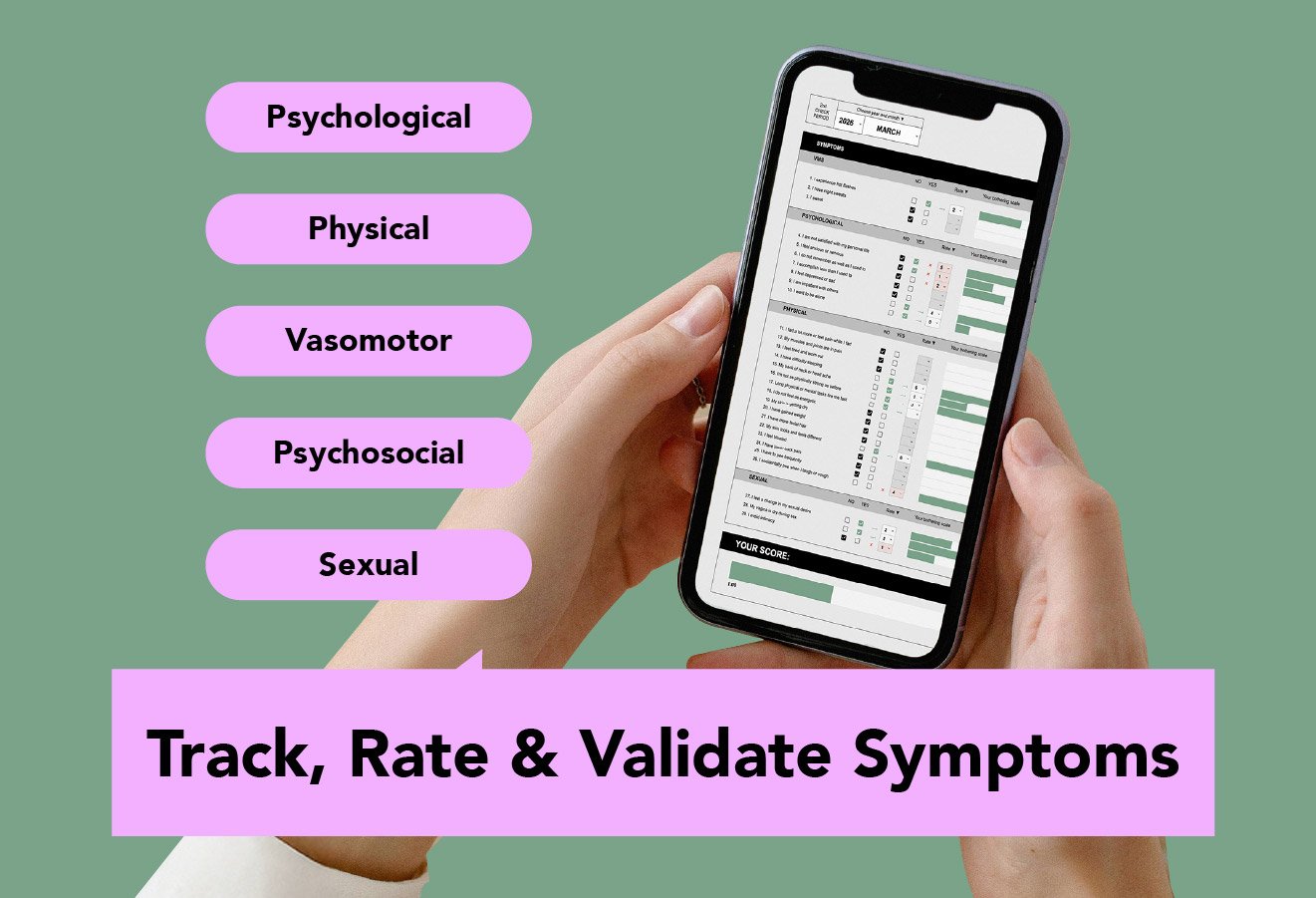
I created this Menopause Transition Questionnaire Set to help you connect the dots. It is a simple yet science-based workbook that helps you see what your body is trying to tell you.
The questionnaires in this workbook aren’t exact copies of the original scientific versions. They’ve been adapted into more understandable language so that any woman can use them easily without losing their scientific accuracy.
Each question captures a different side of the experience: how you sleep, how your mood feels, how your body reacts to heat or stress. When you fill them out more than once, you create a timeline that shows what is changing and what is staying the same.
You can now use the same approach at home to track your own journey with structure and make it easier to advocate for yourself when talking to your doctor.
Use these two evidence-based tools to log symptoms and how they affect you: Greene for symptom burden, MENQOL for quality of life. Complete both in 10–15 minutes, repeat every 4–8 weeks or after treatment changes, and focus on trends (with brief notes) to guide care.


The Greene Scale is a well-known questionnaire that helps measure and understand the symptoms women experience during perimenopause, menopause, and postmenopause.
The GCS was first created in the early 1970s by Dr. John Gerald Greene, a psychologist in Glasgow, Scotland. He developed it after working with women at one of the first menopause clinics in Europe. The questionnaire was built by carefully studying common symptoms women reported during menopause and then tested in several studies. In 1998, Dr. Greene published a paper that helped make the GCS a standard tool for menopause research around the world.
The Greene Climacteric Scale has 21 questions divided into three main areas: psychological, physical and vasomotor symptoms. The questionnaire is easy to fill out on your own and usually takes about five minutes to complete. A higher score means more severe symptoms and a lower quality of life.
“The GCS score on its own doesn’t diagnose menopause. Some symptoms may be caused by low estrogen, while others might have different reasons.”
The score on its own doesn’t diagnose menopause. Some symptoms may be caused by low estrogen, while others might have different reasons. The main purpose of the GCS is to track how your symptoms change over time (naturally or due to treatment), not to give a definite diagnosis.
The Menopause-Specific Quality of Life (MENQOL) Questionnaire measures how menopause affects a woman’s daily life. Unlike general quality-of-life surveys, it focuses only on menopause-related changes, helping to show how symptoms impact physical health, emotions, and social well-being.
MENQOL was developed by nine Canadian researchers and published in 1996. It was one of the first menopause questionnaires based on women’s own experiences and symptoms, not just doctors’ observations.
The MENQOL has 29 questions divided into four main areas: vasomotor, psychosocial, physical and sexual. It’s simple to fill out and usually takes about 5 to 10 minutes to complete. The MENQOL is useful for tracking changes over time, especially to see how treatments are working.
“The MENQOL is useful for tracking changes over time, especially to see how treatments are working.”
Don’t get too hung up on the exact numbers. It’s more about how your symptoms affect you personally, and whether they’re holding you back from living the life you want. Tracking your MENQOL score over time can help you and your healthcare provider see if your symptoms are improving, staying the same, or if a different approach might be needed.
This article is for subscribers only. Unlock step-by-step resources for the menopause transition, built to save time and move you forward now.
Cancel anytime
Already a subscriber? Log in

Member Access Articles

Healthy Body & Mind

Member Access Articles

Treatments & Supplements

Member Access Articles

Understanding Menopause

Scientific Research

Understanding Menopause

Member Access Articles

Lifestyle & Self-Care

Scientific Research

Exercise & Nutrition

Member Access Articles

Symptoms Explained

Member Access Articles

Member Access Articles

Member Access Articles

Treatments & Supplements

Member Access Articles

Scientific Research

We use cookies and similar technologies to ensure the proper functioning of our website, personalize content, provide social media features, and analyze traffic. By clicking “I Agree”, you consent to the use of these technologies.
No results