25 November 2025
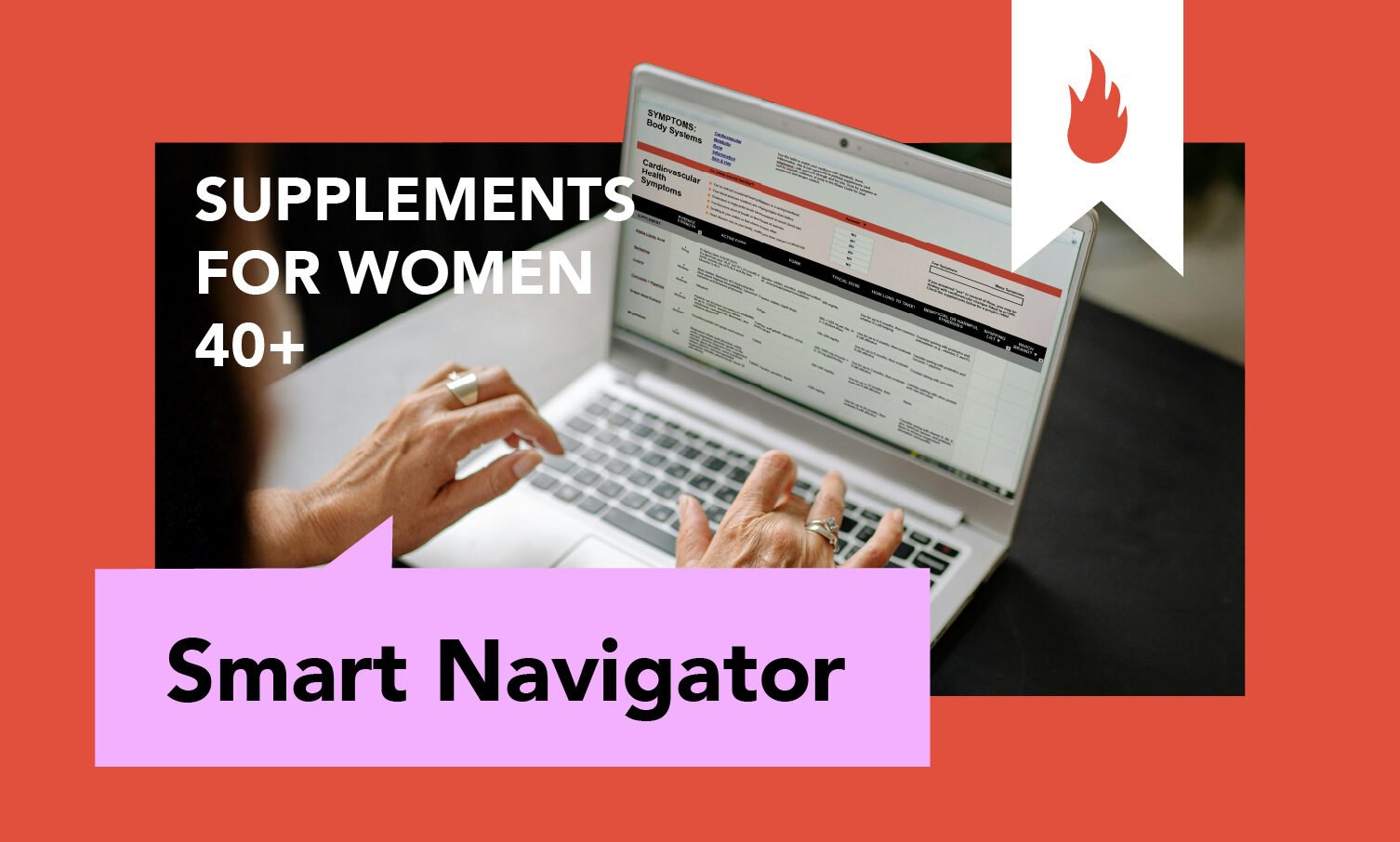
Which Supplements Matter Most Now? Download the Science-Backed Navigator

Reading time 8 min
Reading time 8 min
Supplements are everywhere. Walk into any pharmacy or scroll through social media, and you’ll see promises of glowing skin, balanced hormones, better sleep, more energy… The truth is, not all supplements are created equal, and not all of them are backed by solid science.
That’s why I created The Science-Backed Supplements Navigator for Women 40+ – a downloadable, science-based tool to help you cut through the noise and focus on what works, what’s safe, and what’s worth your money. And because research is constantly evolving, I will be updating this Navigator every quarter with the latest evidence, so you always have the most up-to-date guide at your fingertips.
What are the best supplements for women over 40?
The answer depends on science. This Navigator highlights evidence-based options, explains which are safe, and warns where risks or poor quality exist – helping you skip hype and make informed choices. I rely only on high-quality peer-reviewed journals (Q1–Q2 level), because these provide the most reliable, rigorously reviewed evidence – and we deserve nothing less when it comes to their health.
I included only single-ingredient supplements, not mixed formulas or proprietary blends. There isn’t enough reliable research on combinations, and proprietary blends often hide ingredient amounts or full contents, making it impossible to evaluate their safety or effectiveness1.
SMART NAVIGATOR


A STRUCTURED OVERVIEW of the most relevant supplements for women in perimenopause and menopause.
A CLEAR RATING OF THE EVIDENCE – from early pilot data to robust clinical trials.
EXPLANATIONS of which symptoms or health areas each supplement may help (energy, sleep, mood, bone, skin, metabolism, and more).
A PRACTICAL COMPARISON CHART so you can see at a glance what’s worth considering and what’s just hype.

In your 40s and 50s, small nutrient gaps or hormonal changes can amplify symptoms. A little fatigue, some brain fog, disrupted sleep – and suddenly you’re not sure if it’s your hormones, your diet, or just aging. Supplements may help, but only if you choose wisely.
“Supplements work best when they fill a real gap – not when they’re taken blindly “just in case2.” Low iron, vitamin D deficiency, thyroid issues, or high homocysteine can all mimic or worsen menopause symptoms, but you won’t know unless you test.”
It is smart to start with a solid baseline. Your Smart Guide to Medical Tests After 40 gives you a clear, science-based list of the most important tests for women in menopause transition. Once you know your numbers, you can decide if a supplement is truly necessary.
This approach saves you money, lowers the risk of unnecessary or unsafe supplementation, and gives you peace of mind that you’re targeting the right problem with the right solution.
The Science-Backed Supplements Navigator for Women 40+ is not medical advice. It’s your reference cheatsheet – helping you understand which supplements may be worth considering, what to ask your doctor or pharmacist, and what to avoid. It empowers you to walk into the supplement aisle (or scroll online) with clarity, not overwhelm.


Adaptogens are natural substances, usually herbs or plant extracts, that help the body adapt to stress and maintain balance. They don’t target a single symptom the way most supplements do, but instead work more broadly on the stress response, energy regulation, and resilience3. Supplements usually provide specific nutrients (e.g., vitamin D, iron, B12) to fill a gap or correct a deficiency – often identified by diet assessment or lab tests. While both can be useful during perimenopause and menopause, the key difference is that supplements replace what’s missing, while adaptogens modulate how your body functions under stress.
Adaptogens are one area where the hype often runs ahead of the science, but these findings come from small or early studies. Robust, large-scale trials are still missing, which is why current medical guidelines don’t recommend them for routine use.
In this Navigator, we cover both – what they are, when they’re useful, and where the evidence currently stands.
Not all evidence is created equal. Some supplements are well studied – calcium, vitamin D, and omega-3s, for example, have large, long-term clinical trials behind them4,5,6. Others rely mostly on observational studies, early pilot trials, or even just mechanistic research done in the lab. What looks promising in a lab doesn’t always translate into benefits for real women.
Unfortunately, some companies run very small studies, often lasting just a few weeks, and then market their products as if those results prove long-term, life-changing benefits. These studies are usually too short, too small, and sometimes poorly designed to give reliable answers. That’s why you’ll see bold claims on packaging or websites that aren’t supported by solid science.
Take B-vitamins as an example. B6, B9, and B12 are essential for metabolism, DNA repair, and keeping homocysteine in check. Yet research shows that in well-nourished women, extra supplementation isn’t needed and may carry risks7. I did not include B vitamins or selenium on the list because healthy women do not need supplementation.
This article is for subscribers only. Unlock step-by-step resources for the menopause transition, built to save time and move you forward now.
Cancel anytime
Already a subscriber? Log in
Member Access Articles

Healthy Body & Mind
Member Access Articles

Treatments & Supplements
Member Access Articles

Understanding Menopause
Scientific Research

Understanding Menopause

Member Access Articles

Lifestyle & Self-Care
Scientific Research

Exercise & Nutrition

Member Access Articles
Symptoms Explained
Member Access Articles
Member Access Articles
Member Access Articles
Treatments & Supplements
Member Access Articles

Scientific Research
We use cookies and similar technologies to ensure the proper functioning of our website, personalize content, provide social media features, and analyze traffic. By clicking “I Agree”, you consent to the use of these technologies.
No results