25 November 2025
Science Digest: Creatine Beyond the Gym

Reading time 7 min
Reading time 7 min
This week’s paper, “Creatine in women’s health: bridging the gap from menstruation through pregnancy to menopause”, was published May 2025 in the Journal of the International Society of Sports Nutrition, a respected (Q1), peer-reviewed journal in sports science and nutrition1.
Creatine has long been marketed as a supplement for male athletes chasing performance gains. This paper caught my attention because it moves past gym folklore and looks at what creatine actually does in the female body, from menstruation to menopause, and why it might be far more relevant to women than most realize.
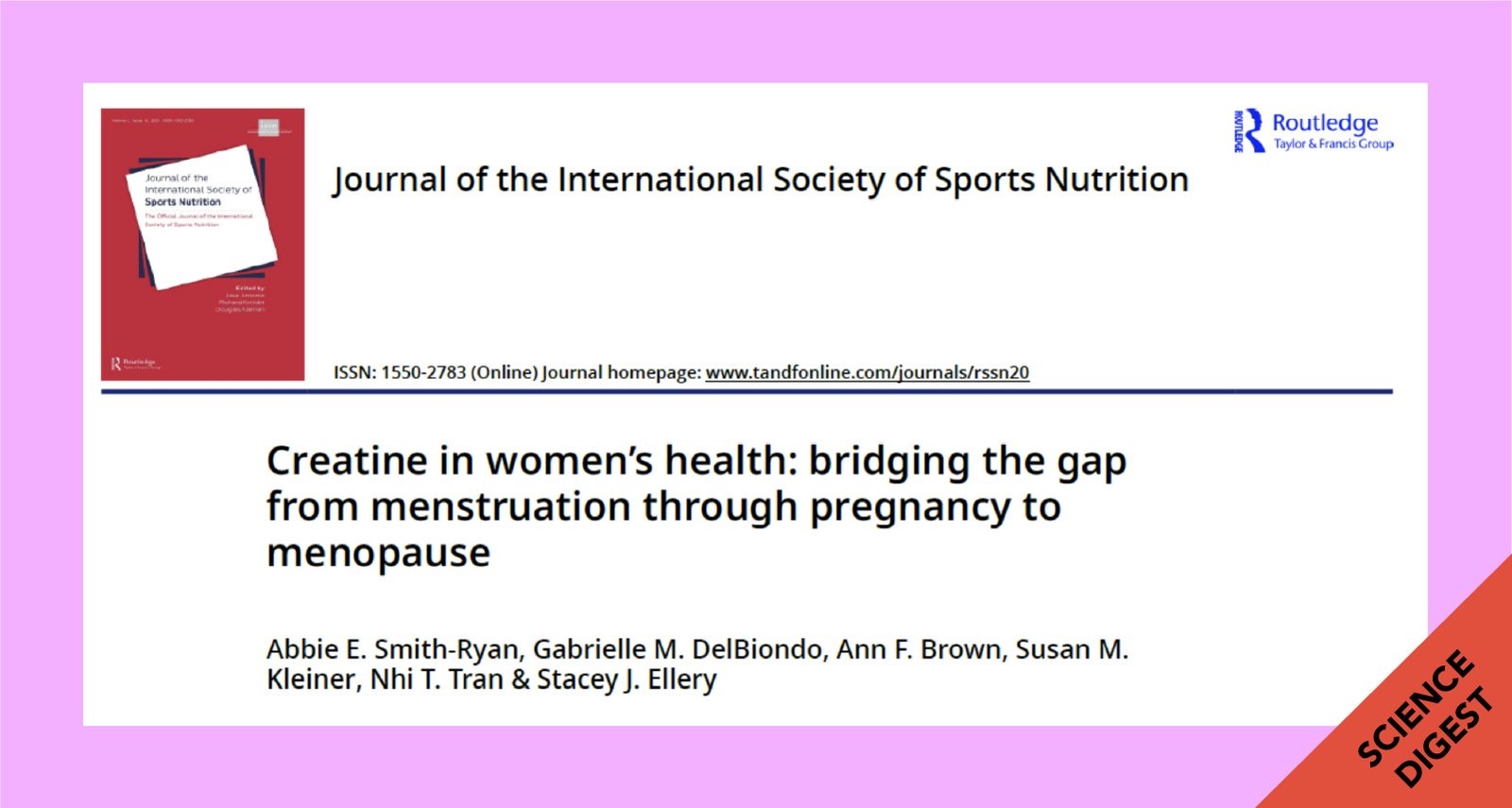
This isn’t a single clinical trial but a comprehensive scientific review that examined existing research on creatine supplementation in women across the lifespan. The authors, led by Dr. Abbie Smith-Ryan, evaluated studies spanning from the 1990s to 2025.
“The review examines creatine’s effects on muscle strength, body composition, cognitive function, mood, sleep, and cellular health in premenopausal, pregnant, perimenopausal, and postmenopausal women.”
Women naturally make about 20% less creatine than men and eat 30–40% less of it (since it mostly comes from meat and fish), creating a baseline gap that hormonal changes can make even larger.
Creatine helped with bloating during the second half of your cycle by improving how your cells handle water, and it boosted cellular health markers during both phases of your cycle. Women who took creatine before strength training slept longer on training nights and reported better recovery. While younger women did show some improvements in training performance, the strongest muscle and strength effects are still seen in older women.
Creatine demand rises to support fetal growth and protect against oxygen stress. Roughly 57% of pregnant women fall below recommended creatine intake. Those who meet or exceed it (around 13 mg/kg/day) have fewer pregnancy complications, though this is correlation rather than proven causation. Early human studies suggest creatine supplementation in pregnancy is safe and potentially protective, but large clinical trials are still underway.
Supplementation may assist with mood stabilization and energy, though evidence here is still emerging.
Not a single study exists on creatine during perimenopause, literally zero research. This is shocking given that this is when women begin losing muscle mass (about 0.7 kg or 1.5 lb per year), bone density declines, fatigue increases, mood becomes less stable, and cognitive changes can begin. The authors argue that, based on evidence from other life stages, creatine may help maintain muscle, bone, energy metabolism, and mood stability during this transition but the data are still missing.
Estrogen loss reduces the body’s ability to synthesize and utilize creatine efficiently. Studies in women over 57 consistently showed that creatine plus strength training helped them build and keep muscle, get stronger, and function better in daily life. The longest study (2 full years) proved that creatine with exercise improved bone structure and muscle mass – the strongest evidence we have for women at any age.
Not all studies are created equal. Most creatine research has been done in younger, athletic men, not midlife women. Although recent trials in postmenopausal women are promising, many are small and short-term.
There’s also variation in dosage (from 3 to 5 grams daily) and study design. We don’t yet have consensus on the best protocol for women across different hormonal stages. Importantly, creatine is safe for most people, but individuals with kidney disease or those taking nephrotoxic medications should consult a physician before starting supplementation.
This review positions creatine not as a muscle-building supplement for athletes but as a metabolic support tool for women’s health across the lifespan. The authors argue that creatine should be seen as a “conditionally essential” nutrient at certain stages of life, especially when hormones shift and diet doesn’t provide enough.
“The authors argue that creatine should be seen as a “conditionally essential” nutrient at certain stages of life, especially when hormones shift and diet doesn’t provide enough.”
This reflects a broader shift toward supporting women’s metabolism, recognizing that women’s bodies aren’t just smaller versions of men’s. Hormonal changes alter energy and recovery, and creatine may help close that gap.
If you’re in your 40s or 50s and feeling your workouts take more out of you than they used to, or if brain fog and fatigue creep in more often, creatine may be worth a try.
The studies showing the greatest benefits used about 3–5 grams daily of creatine monohydrate, taken consistently. It takes 3–4 weeks to reach muscle saturation. For brain benefits, slightly higher maintenance doses (5–10g/day) may be optimal.
Pairing it with regular strength training amplifies results, improving muscle tone, bone health, and overall energy. It’s not a magic powder, but it’s one of the most well-researched supplements with decades of safety data behind it.
This review redefines creatine as a women’s health nutrient, not just a “bro supplement” for muscle gains.
Creatine makes biological sense in perimenopause. This is when muscle loss speeds up, fatigue and brain fog increase, and in addition many women don’t get enough creatine from food.
The problem isn’t that creatine wouldn’t work in perimenopause; it’s that no one’s studied it yet.
What stands out most is how interconnected everything is. Muscle, mood, metabolism, and hormones share the same energetic foundation. The authors are clear-eyed about limitations while making a strong case for creatine as an underutilized tool in women’s health.
For midlife women, creatine isn’t about chasing youth. It’s about protecting the energy systems that help us live fully, think clearly, and stay strong through every transition.
Dr. Jūra Lašas
1.
Smith-Ryan, A. et al. Creatine in women’s health: bridging the gap from menstruation through pregnancy to menopause. (2025) https://doi.org/10.1080/15502783.2025.2502094

Eat to Thrive
Healthy Body & Mind
Brain & Mind Wellness

Treatments & Supplements
Eat to Thrive

Understanding Menopause
Scientific Research

Understanding Menopause

Eat to Thrive

Lifestyle & Self-Care
Scientific Research

Exercise & Nutrition

Eat to Thrive
Symptoms Explained

Eat to Thrive
Eat to Thrive

Scientific Research
Treatments & Supplements

We use cookies and similar technologies to ensure the proper functioning of our website, personalize content, provide social media features, and analyze traffic. By clicking “I Agree”, you consent to the use of these technologies.
No results