22 June 2026
Menopause Workplace Adjustments That Actually Help During Perimenopause

Reading time 16 min.

Reading time 16 min.
The bathroom door is the only one you can actually close. Stepping inside between back-to-back meetings, you run cold water over your wrists, splash the back of your neck, and just breathe.
In your open-plan office, the thermostat is locked at a temperature chosen by someone in facilities. You knew the hot flash was coming. But the word that vanished mid-sentence during your last meeting? That was harder to handle. So was the split second it took to retrieve it, a pause you’re certain your colleagues noticed.
Experiencing perimenopause at work involves a very real biological mechanism. These cognitive shifts directly impact the executive functions your senior role relies on every single day. Here is what the science actually says about menopause in the workplace and how you can manage it.
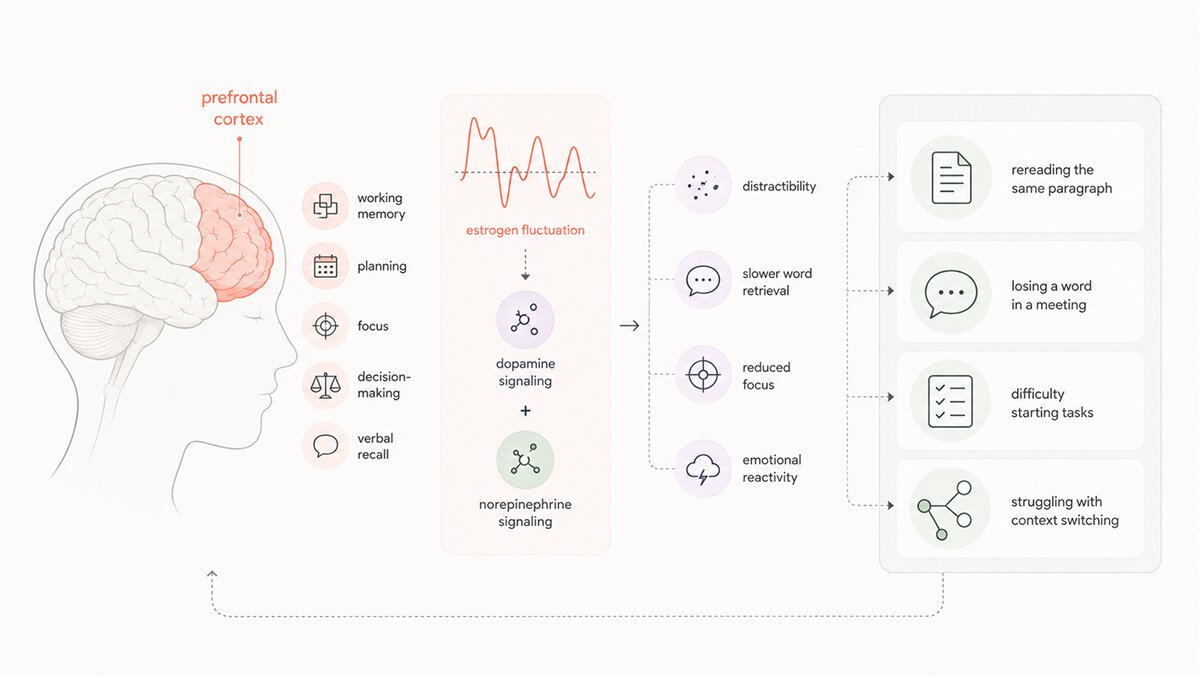
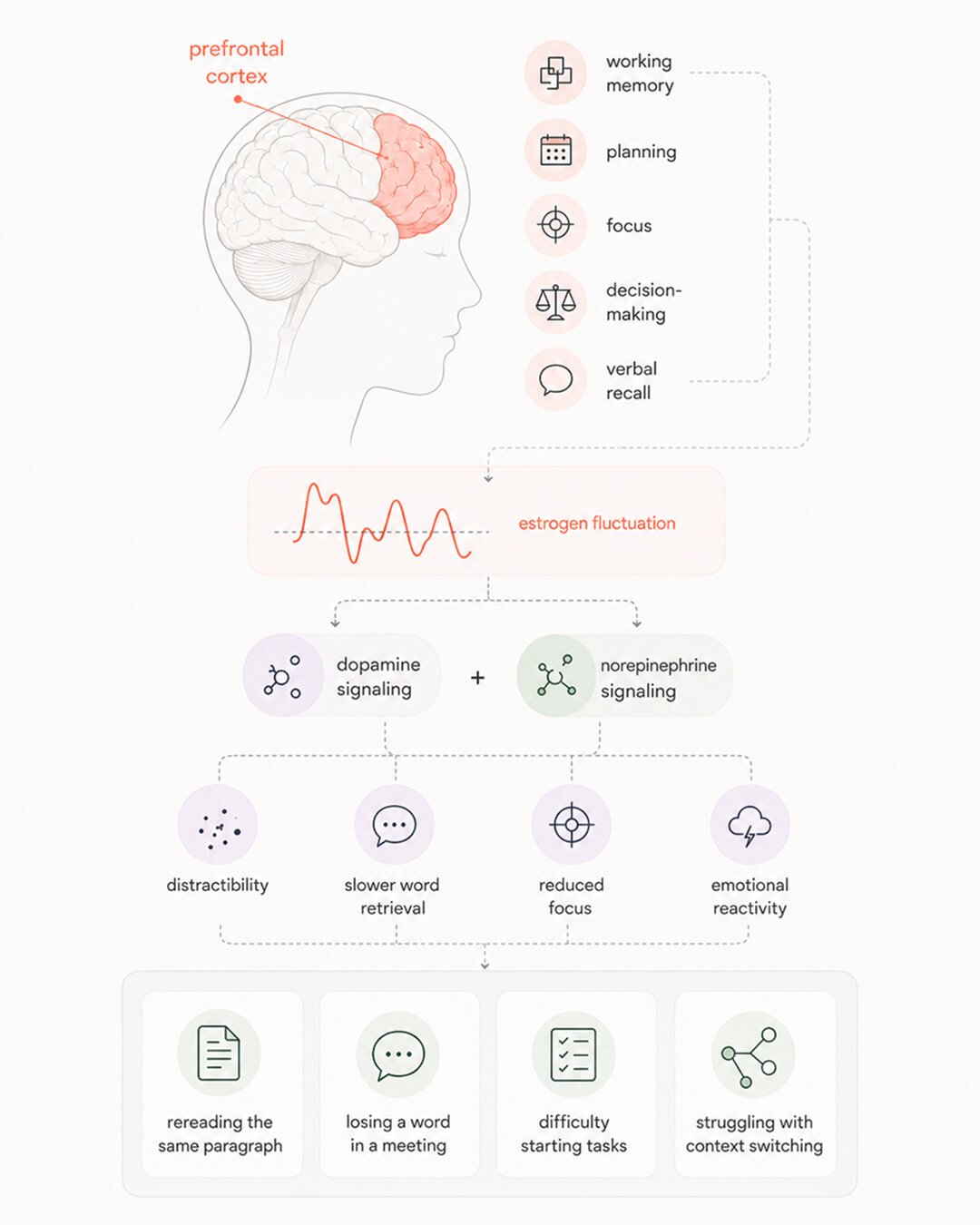
Estrogen is a signaling molecule active throughout the brain. Its receptors are concentrated in the prefrontal cortex, hippocampus, and basal forebrain, which are the regions that run working memory, planning, complex judgment, and how fast you find the right word. Estrogen helps neurons form connections, supports the chemistry of attention and memory, and helps the brain use glucose, which is its main fuel.1,2
When estrogen falls during perimenopause, all of these systems mentioned above are affected. The prefrontal cortex, which is the seat of executive function, is densely populated with estrogen receptors and is one of the regions most sensitive to the change.2,3 Brain scans show that perimenopause changes how the frontal cortex handles short-term memory and focus. While glucose metabolism drops in areas of the brain responsible for higher-level thinking, the brain compensates. Brain blood flow increases, and ATP, the cell’s energy currency, is preserved. Instead of running on empty, the brain simply adapts its energy strategy.1,4
At your desk, the shift is undeniable. You find yourself rereading the same paragraph because the information just won’t stick. The phrase “regulatory framework” is right on the tip of your tongue and then suddenly gone. You walk into a meeting with a clear train of thought, only to lose it halfway through. While these moments might seem small in isolation, they are glaringly obvious in tasks that rely on the prefrontal cortex, which is exactly the kind of high-level thinking your executive role demands.
There is one more crucial piece to the puzzle. Estrogen plays a key role in regulating dopamine and norepinephrine in the prefrontal cortex, the system that drives focus, motivation, and sustained attention. When estrogen drops sharply, dopamine and norepinephrine signaling becomes unstable.5 The result can feel a lot like ADHD, bringing on sudden distractibility, difficulty starting tasks, mental fog, and emotional reactivity that you didn’t have a year ago. While the underlying cause and the treatments are entirely different, the day-to-day experience is similar enough that it causes widespread confusion.
The largest long-term studies tracking cognitive health through the menopause transition offer a more reassuring perspective than the daily lived experience might suggest. Most women experience no global cognitive impairment. Across the Study of Women’s Health Across the Nation (SWAN) and similar longitudinal studies, perimenopause is associated with only small-to-moderate shifts in verbal memory, processing speed, and verbal fluency. Crucially, most women return to their baseline once the transition is complete.6,7
One detailed midlife analysis showed that the odds of experiencing issues with learning, memory, attention, or working memory rose by 41% to 71% from premenopause to early perimenopause. Looking from premenopause all the way to postmenopause, the odds of memory challenges increased by about 76%. These changes are real, though they are concentrated in a specific subset of women. For the majority, the impact is mild. Furthermore, the main factors that make these cognitive symptoms worse are largely modifiable, including severe nighttime hot flashes, disrupted sleep, high stress, and depression.7,8
Fortunately, the foundation of executive work remains entirely intact. Crystallized intelligence and accumulated expertise are unaffected by perimenopause. The pattern recognition, strategic judgment, semantic memory, and deep professional knowledge you have built over the years do not fade during this window. The high-level skills that take twenty years to acquire stay with you. The abilities that suffer temporarily are simply the high-speed, high-load tasks: holding multiple items in your working memory while addressing another, retrieving a specific word under pressure, or switching contexts without warning.6 The work itself is protective.
Curious Fact. Complex work with people protects the brain over decades in a way that complex work with data or things does not. One 2023 analysis in Alzheimer’s & Dementia of 355 older adults found that higher complexity of work with people was linked to a 9% to 12% lower risk of mild cognitive impairment or dementia, better episodic memory, and greater brain reserve, which is the gap between visible brain atrophy and how well someone still functions cognitively. Complex work with data or with things did not show the same effect.9
The work that builds the most brain reserve is the people work. Running negotiations, managing direct reports, mentoring, hiring conversations, conflict resolution, and the social cognitive load of leadership. Sudoku and crossword puzzles are data tasks. They do not carry the same neuroprotective signal. The career you are worried about losing has been building your buffer for years.
Most wellness advice in this space has never actually been tested. The interventions below have, and they are backed by clear biological mechanisms and evidence from randomized controlled trials.
Sleep disruption is the single largest driver of cognitive symptoms during perimenopause. Nighttime hot flashes can wake you briefly without you even realizing it, cutting into your deepest stages of sleep and spiking your cortisol levels. The next day, your memory consolidation, working memory, and reaction times all suffer. Addressing your sleep is often the highest-return intervention you can make.10
The strongest non-drug option is Cognitive Behavioral Therapy for Insomnia, or CBT-I. In a randomized trial of over 100 peri- and postmenopausal women dealing with insomnia and nighttime hot flashes, CBT-I was nearly twice as effective at reducing insomnia symptoms compared to standard menopause education. Even better, the benefits lasted at least six months.11 You don’t need to see a sleep specialist to try it. Self-guided digital CBT-I apps are widely available. Other helpful steps include keeping a consistent wake time, keeping your bedroom cool and dark, and skipping alcohol close to bedtime. It is also worth getting screened for sleep apnea, which becomes more common for women in midlife and can keep disrupting your rest even after you improve your other sleep habits.
Exercise has the strongest non-drug evidence for protecting your brain in midlife. A 2024 review of 42 randomized trials involving nearly 3,000 adults over 45 found that aerobic exercise improved mental flexibility, short-term memory, and focus.12 Working out raises levels of a protein called BDNF (brain-derived neurotrophic factor), which keeps existing neurons healthy and supports the growth of new ones in the hippocampus. For the best overall brain protection, pairing cardio with strength training works better than doing either one alone.
A good baseline routine is 150 minutes a week of moderate-to-vigorous cardio (like brisk walking, running, cycling, or swimming) alongside two strength-training sessions. If you want the biggest boost in BDNF for brain health, high-intensity interval training (HIIT) is the most effective choice. The best part about working out is that its brain benefits compound. By reducing hot flashes, improving sleep, lowering stress hormones, and lifting your mood, exercise tackles brain fog from multiple angles at the same time.
A 2026 analysis published in Alzheimer’s & Dementia followed over 86,000 women and 43,500 men for up to 43 years. The researchers found that closely following a Mediterranean diet was linked to a 21% lower risk of dementia, while following the MIND diet was linked to a 14% lower risk.13 A separate trial looking specifically at postmenopausal women showed that combining cardio with the MIND diet improved both daily function and overall thinking skills. This suggests that the benefits of a good diet and regular exercise actually stack together for even greater brain protection.14
The MIND diet boils down to a simple list of weekly goals:
At the same time, you’ll want to keep red meat, butter, cheese, sweets, and fried food to a minimum.
Hormone replacement therapy is effective for managing menopause symptoms. Its biggest impact on your brain actually comes from removing the two largest disrupters of mental clarity: hot flashes and broken sleep. When it comes to direct brain benefits, timing seems to be important. Research points to a “critical window” hypothesis: starting hormone therapy early, typically within five years of your final period, appears to be neutral or even beneficial for your cognitive skills. On the other hand, starting it much later, years after the transition is over, seems to be neutral or potentially harmful.15
Recent large-scale studies offer reassuring data on the long-term safety and benefits of hormone therapy when it is timed correctly:
Because the delivery route, dose, and timing all matter, this decision is highly individual and belongs in a conversation with a menopause-trained clinician.
Perimenopause arrives at peak professional responsibility and often at a peak caregiving load. Chronic stress raises cortisol, which impairs hippocampal function and weakens the prefrontal cortex connectivity that holds attention and emotional regulation in place. Mindfulness practice works directly on this system.
A 2025 review of 19 randomized trials involving nearly 1,700 menopausal women found that mindfulness practices made a big difference in reducing anxiety, depression, and stress, while significantly improving sleep quality.18 The most thoroughly researched version is Mindfulness-Based Stress Reduction (MBSR), an eight-week program originally developed at the University of Massachusetts Medical School. You can easily find this program online or through apps. Real-world studies show that even a brief, consistent practice of just 10 to 20 minutes a day delivers noticeable benefits.
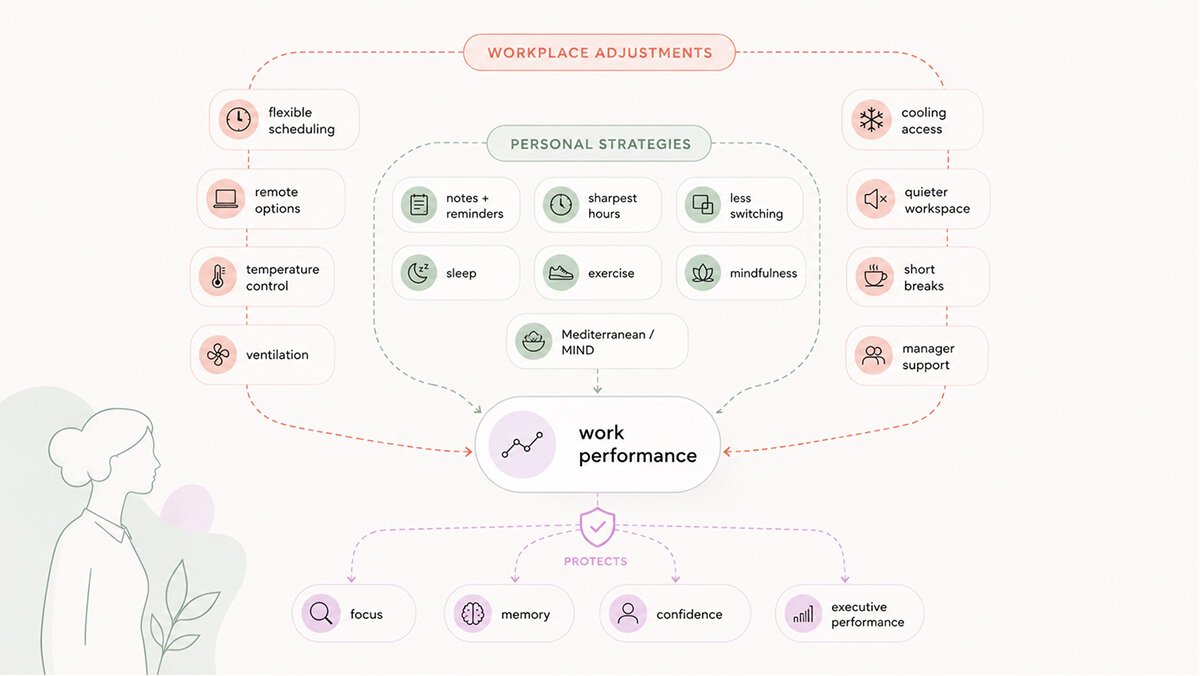
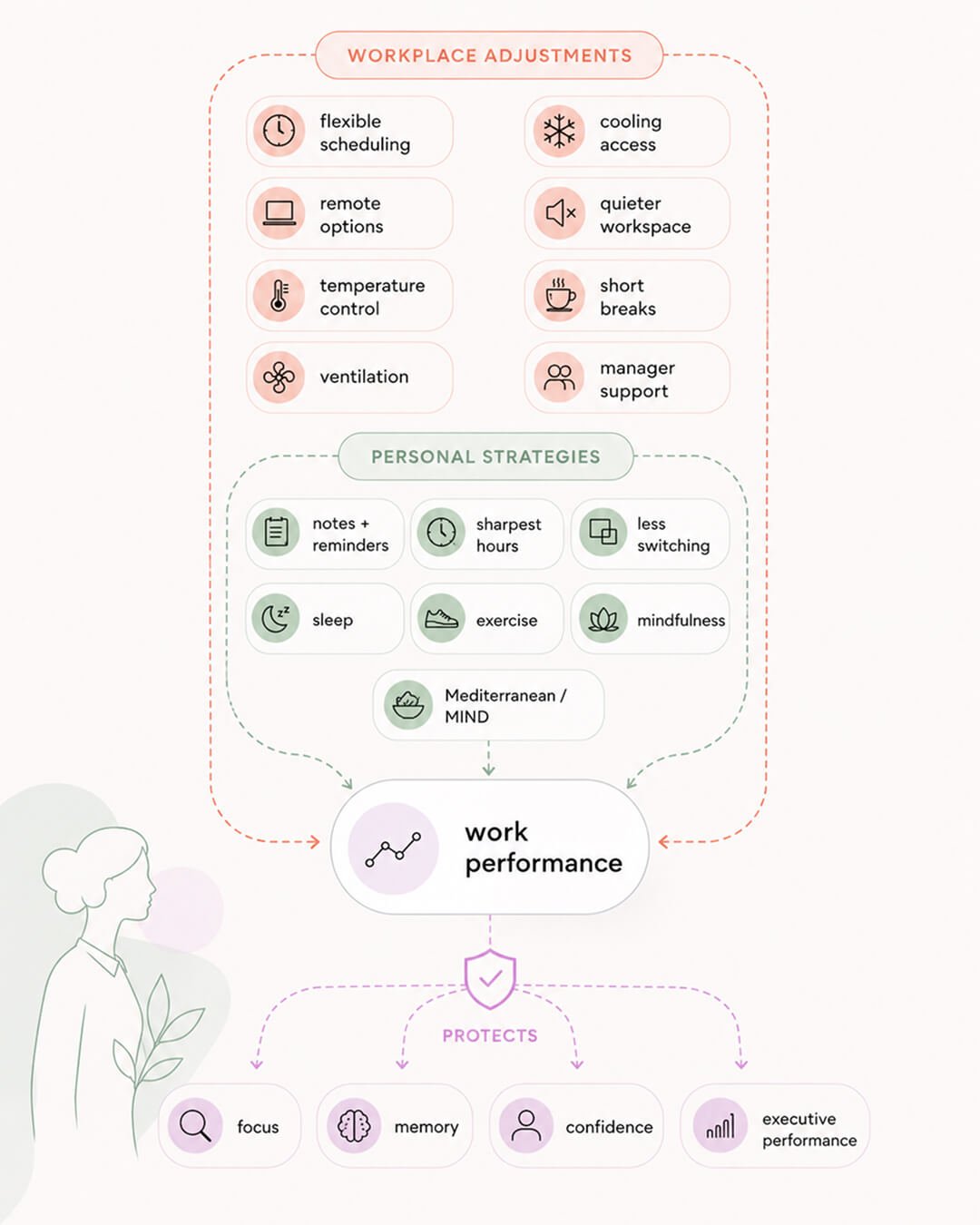
Biology is one part of this. The other part is how you structure your day around the biology. None of what follows requires asking permission from anyone.
The cognitive function under the most pressure in perimenopause is working memory, which is the system that lets you hold information in mind while you do something with it. Write everything down. Use structured note-taking, voice-to-text capture, written agendas with explicit decisions, and one trusted task system. Every item you offload is bandwidth returned to the work that actually requires you.
Cognitive symptoms in perimenopause fluctuate. For most women, morning is the sharpest. Block your most demanding work, strategy, complex writing, and important decisions into your sharpest two-hour windows. Save email, status updates, and operational triage for lower-energy periods. Protect a 90-minute uninterrupted block at least once a day. Context-switching is harder on working memory now, so build the day to minimize it.
What stays intact is exactly what makes you so valuable: your pattern recognition, judgment under uncertainty, ability to read a room, deep industry expertise, and the professional relationships you’ve built over a career. Lead with that depth. When your symptom burden is heavy, delegate the high-speed, fast-shifting tasks that require intense short-term focus. Making this kind of shift is a smart, effective way to manage your workload during a temporary transition.
The constant self-monitoring that follows a mental slip, the rumination after a meeting, and the late-night replays all consume precious prefrontal cortex bandwidth. In fact, worrying about whether you will lose your next word eats up the exact mental resources you need to retrieve it. Simply recognizing a lapse as temporary and biological can instantly lower that secondary mental tax. While all the strategies mentioned earlier help, especially prioritizing your sleep, mindfulness is particularly effective at breaking this exact cycle of overthinking.
When managing menopause symptoms at work, it is vital to distinguish between general online advice and rigorously tested, proven strategies. Currently, CBT boasts the strongest clinical evidence for workplace success. By teaching women to reframe in-the-moment anxiety, such as panicking over a hot flash during a presentation or a forgotten word, CBT breaks the “catastrophizing loop” that exacerbates both physical and mental symptoms.19 This structured, self-guided approach significantly improves sleep and daytime productivity while drastically reducing “presenteeism.” Alongside CBT, providing straightforward health education naturally lowers anxiety by helping women understand their biological changes, making symptoms feel far more manageable and empowering them to make informed choices.
Beyond individual psychological tools, systemic organizational support is crucial, most notably through targeted manager training. Short educational sessions effectively equip supervisors to offer practical adjustments and support without overstepping boundaries, sparing you the burden of having to educate your own bosses.20 While flexible hours and remote work remain the most sought-after accommodations, they can stall professional growth if not backed by an informed, open company culture. Furthermore, though environmental tweaks like temperature control and better ventilation lack extensive clinical trials, they are inexpensive and biologically logical necessities. Ultimately, the most effective workplace strategy combines these cultural and psychological changes with practical accommodations, ensuring you are both communicatively supported and physically comfortable.
For decades, perimenopause in the workplace has been brushed off as a confidence problem. The science says otherwise. The drop in estrogen affects the prefrontal cortex circuits that executive jobs rely on, and those changes are entirely real. For most women, the cognitive changes are temporary. While the cognitive shifts might feel massive in the moment, they are objectively small and highly modifiable through sleep, exercise, diet, stress management, and properly timed hormone therapy.
Perhaps the most useful way to look at it is this: the complex, high-level work you do every day is actively building the cognitive reserve that will protect your brain later in life. Your edge is completely intact. You are simply passing through a measurable, biological transition, and you have the tools to manage it.
Dr. Jura Lasas
1.
Mosconi, L. et al. Menopause impacts human brain structure, connectivity, energy metabolism, and amyloid-beta deposition. Scientific Reports (2021). https://doi.org/10.1038/s41598-021-90084-y
2.
Shanmugan, S. and Epperson, C.N. Estrogen and the prefrontal cortex: Towards a new understanding of estrogen’s effects on executive functions in the menopause transition. Human Brain Mapping (2014). https://doi.org/10.1002/hbm.22218
3.
Mosconi, L. et al. In vivo brain estrogen receptor density by neuroendocrine aging and relationships with cognition and symptomatology. Scientific Reports (2024). https://doi.org/10.1038/s41598-024-62820-7
4.
Berent-Spillson, A. et al. Hormonal environment affects cognition independent of age during the menopause transition. Journal of Clinical Endocrinology and Metabolism (2012). https://doi.org/10.1210/jc.2012-1365
5.
Metcalf, C.A. et al. Cognitive Problems in Perimenopause: A Review of Recent Evidence. Current Psychiatry Reports (2023). https://doi.org/10.1007/s11920-023-01447-3
6.
Greendale, G.A. et al. Effects of the menopause transition and hormone use on cognitive performance in midlife women. Neurology (2009). https://doi.org/10.1212/WNL.0b013e3181a71193
7.
Maki, P.M. and Jaff, N.G. Brain fog in menopause: a health-care professional’s guide for decision-making and counseling on cognition. Climacteric (2022). https://doi.org/10.1080/13697137.2022.2122792
8.
Maki, P.M. et al. Cognitive changes during the menopausal transition: a longitudinal study in women with and without HIV. Menopause (2021). https://doi.org/10.1097/GME.0000000000001725
9.
Coleman, M.E. et al. Social enrichment on the job: Complex work with people improves episodic memory, promotes brain reserve, and reduces the risk of dementia. Alzheimer’s & Dementia (2023). https://doi.org/10.1002/alz.13035
10.
Baker, F.C. et al. Sleep and Sleep Disorders in the Menopausal Transition. Sleep Medicine Clinics (2018). https://doi.org/10.1016/j.jsmc.2018.04.011
11.
McCurry, S.M. et al. Telephone-Based Cognitive Behavioral Therapy for Insomnia in Perimenopausal and Postmenopausal Women With Vasomotor Symptoms: A MsFLASH Randomized Clinical Trial. JAMA Internal Medicine (2016). https://doi.org/10.1001/jamainternmed.2016.1795
12.
Ye, M. et al. Effects of aerobic exercise on executive function of healthy middle-aged and older adults: A systematic review and meta-analysis. International Journal of Nursing Studies (2024). https://doi.org/10.1016/j.ijnurstu.2024.104912
13.
Liu, X. et al. Long-term adherence and changes in the Mediterranean and MIND diets in relation to dementia risk and cognitive function. Alzheimer’s & Dementia (2026). https://doi.org/10.1002/alz.71324
14.
Akbaraly, T. et al. Aerobic Exercise with Mediterranean-DASH Intervention for Neurodegenerative Delay Diet Promotes Brain Cells’ Longevity despite Sex Hormone Deficiency in Postmenopausal Women: A Randomized Controlled Trial. Oxidative Medicine and Cellular Longevity (2022). https://doi.org/10.1155/2022/4146742
15.
Maki, P.M. Critical window hypothesis of hormone therapy and cognition: a scientific update on clinical studies. Menopause (2013). https://doi.org/10.1097/GME.0b013e3182960cf8
16.
Gleason, C.E. et al. Long-term cognitive effects of menopausal hormone therapy: Findings from the KEEPS Continuation Study. PLOS Medicine (2024). https://doi.org/10.1371/journal.pmed.1004435
17.
Puri, T.A. et al. Association Between Menopause Age and Estradiol-Based Hormone Therapy With Cognitive Performance in Cognitively Normal Women in the CLSA. Neurology (2025). https://doi.org/10.1212/WNL.0000000000213995
18.
Liu, S. et al. The effectiveness of mindfulness-based interventions on menopausal symptoms: A systematic review and meta-analysis of randomized controlled trials. (2025). https://doi.org/10.1016/j.jad.2025.04.029
19.
Kalmbach, D. et al. Improving Daytime Functioning, Work Performance, and Quality of Life in Postmenopausal Women With Insomnia (2019). https://doi.org/10.5664/jcsm.7882
20.
Geukes, M. et al. Evaluation of a workplace educational intervention on menopause: A quasi-experimental study (2023). https://doi.org/10.1016/j.maturitas.2023.05.005

Mood & Energy Solutions

Fatigue Causes & Types

Fatigue Causes & Types
Workplace Strategies

Menopause at Work

Brain Fog at Work

Brain Fog at Work

Is This Perimenopause?

Is This Perimenopause?

Nutrition & Supplements

Workplace Strategies

Menopause Science

Menopause Science

Brain Fog Solutions
We use cookies and similar technologies to ensure the proper functioning of our website, personalize content, provide social media features, and analyze traffic. By clicking “I Agree”, you consent to the use of these technologies.
No results