18 June 2025
Best Supplements for Menopause Brain Fog: What the Evidence Actually Shows

Reading time 12 min

Reading time 12 min
Walk into a pharmacy in Stockholm or London or New York and you find the same supplement wall “Menopause supplements.” Capsules, sachets, gummies, and drops all promise relief from brain fog, more energy, sharper focus, and mental clarity. Labels love the word ‘support’ because it promises everything while guaranteeing nothing.
Most of the supplements on the menopause shelf have never been tested on women like us. Lion’s mane, bacopa, ashwagandha, turmeric, omega-3, sometimes all five in a single capsule with an asterisk that the claims have not been evaluated by any regulatory authority. The honest question for the best supplements for menopause brain fog is which menopause cognitive supplements have direct evidence in perimenopausal and postmenopausal women, which rest on mechanism alone, and which are sold with confidence the data does not support.
The menopause brain fog most of us notice in our 40s originates in the brain since estrogen receptors are found throughout the brain. The highest density of the receptors is in the hippocampus, the structure responsible for encoding new memories and pulling words back when we need them. When estrogen levels become erratic and then decline, the receptors stop getting the signal they evolved to expect. Verbal learning and verbal memory are the cognitive functions most consistently affected, and the disruption is most pronounced during perimenopause itself.¹
Estrogen also regulates how neurons use glucose and how the blood vessels supplying the brain respond to demand. Brain imaging across the menopause transition has documented changes in structure, connectivity, and energy metabolism, with reductions in glucose uptake and gray matter volume that partially recover after menopause stabilizes.² A useful supplement, if it exists, has to address one of these specific targets: the energy gap, the blood-flow response, or a deficient micronutrient that was already affecting cognition.
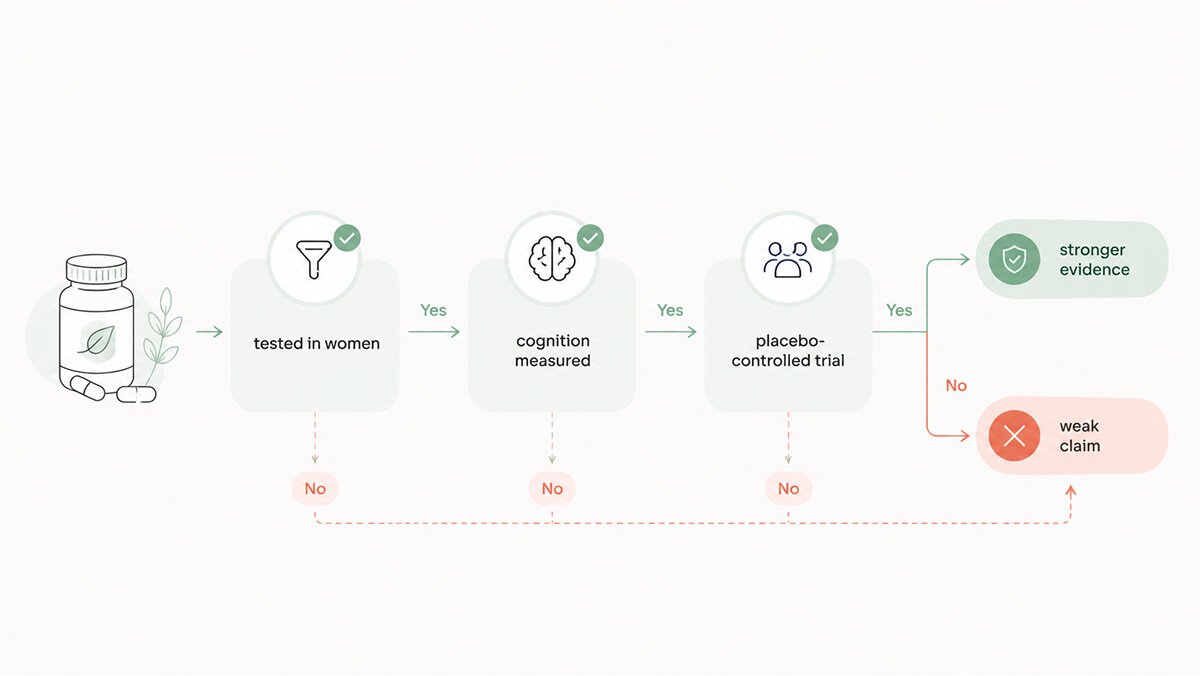
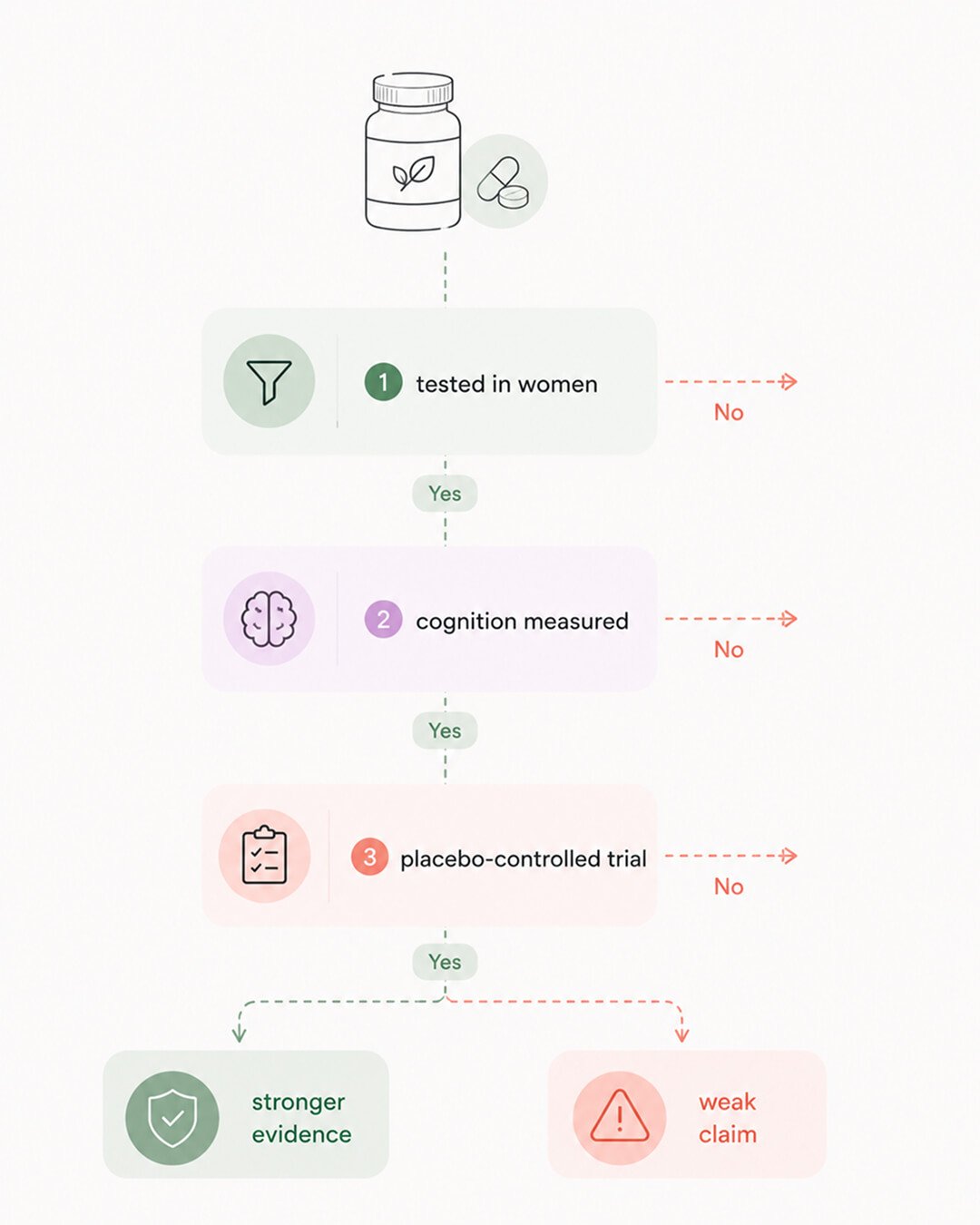
Before buying any supplement, you should ask three questions to decide whether it is the best supplement for menopause brain fog:
Most products on the menopause shelf cannot answer yes to all three.
Lion’s mane. The mechanism is genuinely interesting, since lion’s mane stimulates nerve growth factor, which supports neuron health and connectivity. Marketing claims that the mushroom improves memory, focus, mental clarity, and long-term brain health. The human data does not match the marketing. The most cited human trial enrolled 30 older Japanese adults with mild cognitive impairment, showed cognitive improvement at 16 weeks, and lost the effect within 4 weeks of stopping the supplement.3 No randomized controlled trial has been conducted in perimenopausal or postmenopausal women.
Bacopa monnieri. Marketed for memory and calm focus, with claims about sharpening focus and boosting BDNF. In the most rigorous recent trial, 101 adults aged 40 to 70 with self-reported memory and attention problems took 300 mg of standardized Bacopa for 12 weeks. The supplement produced no improvement on the outcomes of verbal learning, attention, or working memory, though stress reactivity and post-task fatigue improved modestly.4 No randomized trial in menopausal women exists.
Ashwagandha. Acts as an adaptogen, suppresses the hypothalamic signal that drives cortisol, and is marketed as a fix for stress, sleep, and hormones. Trials in chronically stressed adults show some cortisol reduction.5 A perimenopause-specific trial of 100 women showed improvements in total Menopause Rating Scale scores, with parallel changes in serum estradiol and FSH after 8 weeks of 300 mg twice daily.⁶ The trial measured menopausal symptoms broadly, not cognition. The stress and cortisol angle is real, but there are no studies for menopause brain fog specifically.
Turmeric and standard curcumin. The mechanism is broad: anti-inflammatory, antioxidant, modulation of cell signaling. The 2025 systematic review of 12 randomized trials in postmenopausal women found no significant effects on physical, psychological, or sexual functions, with conflicting findings on vasomotor symptoms.⁷ Standard curcumin is poorly absorbed, and absorption can vary significantly across formulations. Whether a better-absorbed formulation would work in perimenopausal or menopausal women, no one has tested.
Omega-3 (EPA and DHA). Animal work in ovariectomized mice is encouraging, with restored memory and reduced brain inflammation. Human data is more sober. A 2023 systematic review of nine trials in postmenopausal women found possible benefits on vasomotor symptoms in four trials, with inconclusive effects on sleep and depression and no clear cognitive signal.8 Omega-3 has cardiovascular and metabolic value, and better cardiovascular health supports brain blood flow indirectly. The direct claim that omega-3 fixes perimenopause brain fog is not supported.
Soy isoflavones. They act as gentle estrogen-receptor modulators, with the highest activity at the receptors most expressed in the hippocampus. Small trials look positive. The two largest trials in postmenopausal women found no significant cognitive effect. This is the small-study bias pattern, where small trials show effects that disappear when the studies are large enough.
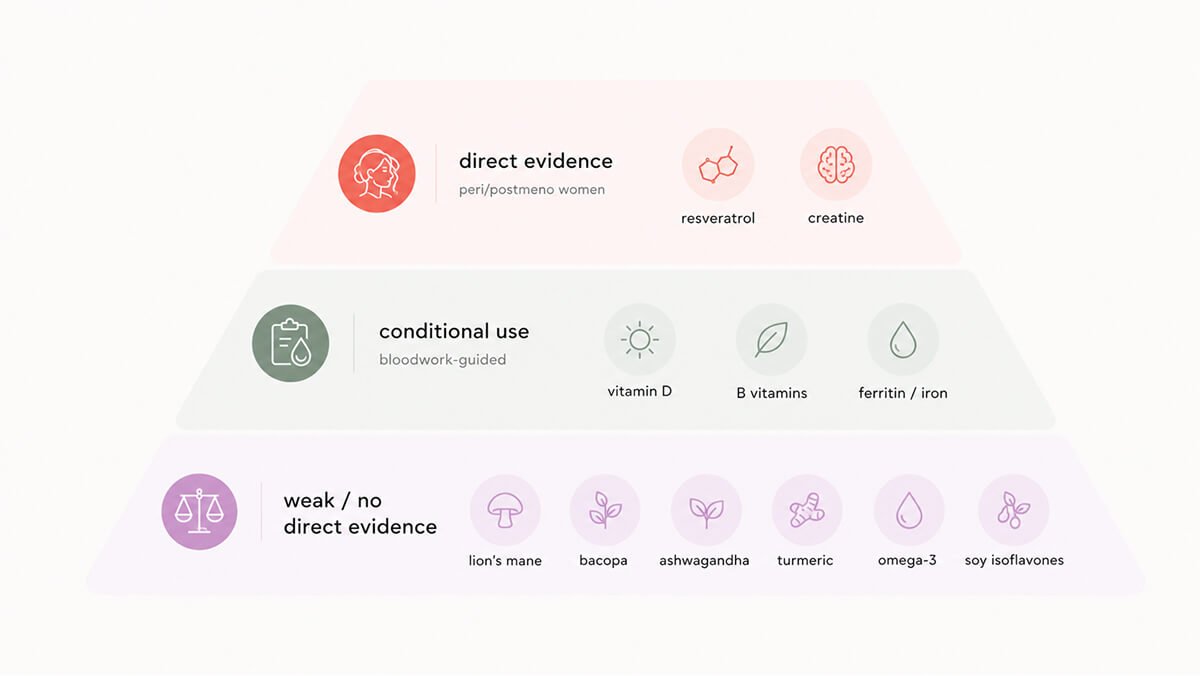
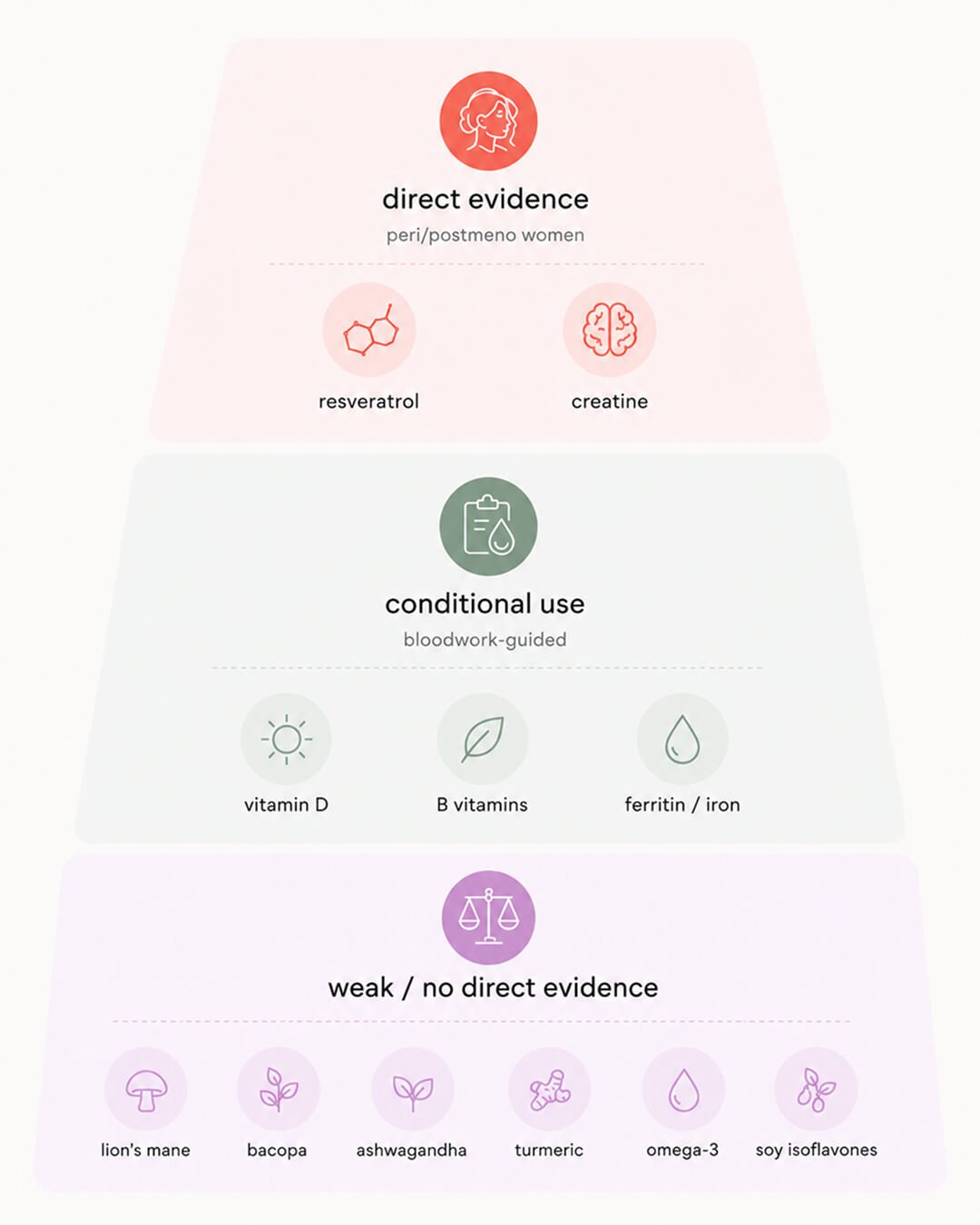
Two supplements have good evidence addressing menopause brain fog, but they are indicated only for women whose blood work shows they actually need them.
Vitamin D. In a one-year randomized trial of overweight postmenopausal women with vitamin D below 30 ng/mL, the 2,000 IU/day group performed best on learning and memory tests. The 4,000 IU/day group had slower reaction times than the lowest dose.9 Vitamin D cognitive function in menopause appears to follow an inverted-U curve, where the benefit is correcting deficiency, not pushing levels higher than they need to be. The Women’s Health Initiative analysis of 4,143 women aged 65 and older found no overall benefit of 400 IU vitamin D plus calcium for cognitive performance,¹⁰ which is consistent with the deficiency-correction interpretation rather than a general cognitive effect.
B vitamins. The story is one word: homocysteine. High homocysteine is independently neurotoxic, and B12, B6, and folate are how the body keeps homocystein in check. B vitamin supplementation slowed cognitive decline in trials of older adults with mild cognitive impairment and elevated homocysteine.¹¹ Pooled analyses of trials in adults whose homocysteine was already normal show no benefit.¹² In the Women’s Health Initiative Memory Study of 7,030 postmenopausal women, folate intake below the recommended daily allowance was associated with a doubled risk of mild cognitive impairment or probable dementia.13 Test homocysteine and fix it if it is high.
Resveratrol. Trans-resveratrol at 150 mg per day has been tested in randomized trials in postmenopausal women with cognition measured directly. An 80-woman study lasting 14 weeks found that the brain’s blood flow improved by 17% when challenged by mental tasks or changes in breathing. Along with this better circulation, the women also showed sharper memory and better overall thinking skills.14 The 24-month follow-up trial in 125 postmenopausal women confirmed a roughly 33% improvement in overall cognitive performance, with the largest gains in verbal memory among women aged 65 and older.15
The mechanism connects to the perimenopause brain fog directly. Resveratrol acts as a phytoestrogen on blood vessel walls and increases nitric oxide production, which is the signal that tells blood vessels to relax and let more blood through. The perimenopausal brain struggles to increase blood flow to regions that are working hard, and resveratrol seems to address that specific deficit. Of everything reviewed, resveratrol at 150 mg per day has the most consistent randomized trial evidence in postmenopausal women. Direct trials testing if resveratrol is one of the best supplements for menopause brain fog in perimenopausal women are still missing.
Creatine. Most of us know creatine as a bodybuilder supplement. The brain uses it too, and quite a lot of it. Neurons run on ATP, the brain’s energy currency, and burn through it fast during sustained attention or high-stakes decisions. ATP is regenerated from a backup pool called phosphocreatine, which acts as a millisecond-scale battery. Creatine is what that battery is made from. We start with 20 to 30% lower creatine stores than men, and estrogen helps maintain the reserve, so when estrogen withdraws, the reserve shrinks.16
In a 2025 randomized trial of 36 perimenopausal and postmenopausal women, 1,500 mg of creatine HCl daily for 8 weeks improved reaction time and raised frontal brain creatine by 16.4%, while placebo showed no change in either.¹⁷ A 2024 meta-analysis of 16 trials in adults found that creatine improved memory, attention, and processing speed, with the strongest effects in women specifically.¹⁸ The perimenopause trial was small, with roughly nine women per arm, and replication is needed before this becomes a confident recommendation. It currently has the strongest direct evidence as one of the best supplements for menopause brain fog, alongside resveratrol.
A 2025 study of perimenopausal women whose standard blood work looked normal found that lower iron status, even within the normal range, was associated with worse attention and memory.19 The women were not anemic and their hemoglobin levels were fine. Ferritin, the stored form of iron, can drop substantially while standard hemoglobin stays normal, and perimenopause often arrives with heavy or irregular periods that can drain iron stores.
There is no randomized trial yet of iron supplementation for menopause brain fog, only observational evidence. Ferritin is cheap to measure and easy to correct. Before trying any supplements for perimenopause brain health, ferritin should be one of the first markers checked.
The honest answer about the best supplements for menopause brain fog is that the question is asked in the wrong order. Two supplements have direct randomized evidence in perimenopausal or postmenopausal women with cognitive outcomes measured directly: resveratrol and creatine. A few are conditional on lab values. The rest are sold with confidence the data does not support.
We are at peak earning years and our brains are negotiating a real biological transition. The bloodwork, the sleep, the training, and the cognitive load matter more than the supplement aisle, and the two supplements that earned their place earned it by being tested in women like us.
Dr. Jūra Lašas
1.
Metcalf CA, et al. Cognitive Problems in Perimenopause: A Review of Recent Evidence (2023). https://doi.org/10.1007/s11920-023-01447-3
2.
Mosconi L, et al. Menopause impacts human brain structure, connectivity, energy metabolism, and amyloid-beta deposition (2021). https://doi.org/10.1038/s41598-021-90084-y
3.
Mori K, et al. Improving effects of the mushroom Yamabushitake (Hericium erinaceus) on mild cognitive impairment: a double-blind placebo-controlled clinical trial (2009). https://doi.org/10.1002/ptr.2634
4.
Lopresti AL, et al. The Effects of a Bacopa monnieri Extract (Bacumen®) on Cognition, Stress, and Fatigue in Healthy Adults: A Randomized, Double-Blind, Placebo-Controlled Trial (2025). https://doi.org/10.1007/s40261-025-01492-1
5.
Chandrasekhar K, et al. A Prospective, Randomized Double-Blind, Placebo-Controlled Study of Safety and Efficacy of a High-Concentration Full-Spectrum Extract of Ashwagandha Root in Reducing Stress and Anxiety in Adults (2012). https://doi.org/10.4103/0253-7176.106022
6.
Gopal S, et al. Effect of an ashwagandha (Withania Somnifera) root extract on climacteric symptoms in women during perimenopause: A randomized, double-blind, placebo-controlled study (2021). https://doi.org/10.1111/jog.15030
7.
Akyakar B, et al. The Effect of Curcumin on Postmenopausal Symptoms: A Systematic Review Based on Randomized Controlled Trials (2025). https://doi.org/10.3390/ijms26178260
8.
Iqbal A, et al. Effects of Omega-3 Polyunsaturated Fatty Acids Intake on Vasomotor Symptoms, Sleep Quality and Depression in Postmenopausal Women: A Systematic Review (2023). https://doi.org/10.3390/nu15194231
9.
Castle M, et al. Three Doses of Vitamin D and Cognitive Outcomes in Older Women: A Double-Blind Randomized Controlled Trial (2019). https://doi.org/10.1093/gerona/glz041
10.
Rossom RC, et al. Calcium and vitamin D supplementation and cognitive impairment in the Women’s Health Initiative (2012). https://doi.org/10.1016/j.jnha.2024.100190
11.
de Jager CA, et al. Cognitive and clinical outcomes of homocysteine-lowering B-vitamin treatment in mild cognitive impairment: a randomized controlled trial (2012). https://doi.org/10.1002/gps.2758
12.
Ford AH, Almeida OP. Effect of Vitamin B Supplementation on Cognitive Function in the Elderly: A Systematic Review and Meta-Analysis (2019). https://doi.org/10.1007/s40266-019-00649-w
13.
Agnew-Blais J, et al. Folate, vitamin B-6, and vitamin B-12 intake and mild cognitive impairment and probable dementia in the Women’s Health Initiative Memory Study (2015). https://doi.org/10.1016/j.jand.2014.07.006
14.
Evans HM, et al. Effects of Resveratrol on Cognitive Performance, Mood and Cerebrovascular Function in Post-Menopausal Women: A 14-Week Randomised Placebo-Controlled Intervention Trial (2017). https://doi.org/10.3390/nu9010027
15.
Thaung Zaw JJ, et al. Long-term effects of resveratrol on cognition, cerebrovascular function and cardio-metabolic markers in postmenopausal women: A 24-month randomised, double-blind, placebo-controlled, crossover study (2020). https://doi.org/10.1016/j.clnu.2020.08.025
16.
Smith-Ryan AE, et al. Creatine in women’s health: bridging the gap from menstruation through pregnancy to menopause (2025). https://doi.org/10.1080/15502783.2025.2502094
17.
Korovljev D, et al. The Effects of 8-Week Creatine Hydrochloride and Creatine Ethyl Ester Supplementation on Cognition, Clinical Outcomes, and Brain Creatine Levels in Perimenopausal and Menopausal Women (CONCRET-MENOPA): A Randomized Controlled Trial (2025). https://doi.org/10.1080/27697061.2025.2551184
18.
Xu C, et al. The effects of creatine supplementation on cognitive function in adults: a systematic review and meta-analysis (2024). https://doi.org/10.3389/fnut.2024.1424972
19.
Barnett AL, et al. Cognitive Performance in Relation to Systemic and Brain Iron at Perimenopause (2025). https://doi.org/10.3390/nu17050745

Mood & Energy Solutions

Fatigue Causes & Types

Fatigue Causes & Types

Workplace Strategies

Menopause at Work

Brain Fog at Work

Brain Fog at Work

Is This Perimenopause?

Is This Perimenopause?

Nutrition & Supplements

Workplace Strategies

Menopause Science

Menopause Science
Brain Fog Solutions

We use cookies and similar technologies to ensure the proper functioning of our website, personalize content, provide social media features, and analyze traffic. By clicking “I Agree”, you consent to the use of these technologies.
No results