22 June 2026
Perimenopause Fatigue: Why You’re Exhausted All the Time and How to Get Your Energy Back

Reading time 15 min.

Reading time 15 min.
It’s 2:00 p.m. You sit down to prep for a meeting that you could have led in your sleep three years ago. You pull up a document, read the first paragraph, and immediately have to read it again. And then a third time. You are working twice as hard to absorb half as much information. This isn’t laziness, and you haven’t lost your drive. This is perimenopause fatigue settling in right during the prime hours you used to rely on for high-stakes work. While the public conversation around why women feel perimenopausal exhaustion still largely centers on hot flashes and broken sleep, the reality is far more neurological.
The reality of being exhausted carries a measurable professional toll. In a Mayo Clinic study of more than 4,400 employed women between the ages of 45 and 60, over 13% reported negative career outcomes directly tied to their symptoms. For those experiencing the most severe symptoms, the likelihood of career disruption multiplied by more than fifteen. Across the United States, missed workdays tied to these physiological shifts cost an estimated $1.8 billion in lost wages annually.1 In 2024, The Menopause Society issued its first-ever workplace consensus, explicitly confirming that the biological changes predict reduced productivity, increased absences, and sometimes an early exit from the workforce right during peak earning years.2
Behind those statistics is a frustrating daily reality. At 10:00 a.m., you might easily command a complex strategy session. But by 2:00 p.m., just searching for the right word in a similar meeting takes visible effort. You used to knock out four major decisions before lunch; now, making just two feels like the hardest part of your day. The drain on your energy originates in four specific neurological networks: attention, executive function, stress recovery, and motivation. Because estrogen helps regulate each of these networks, they all begin to operate differently during the transition.
When doctors simply recommend getting more sleep or managing stress, they are only addressing a tiny fraction of the problem. To truly understand what is happening, we need to look at the machinery itself.
Staying awake isn’t a passive state; it requires continuous biological effort. Deep within your brainstem, a tiny cluster of neurons called the locus coeruleus produces norepinephrine to maintain your alertness as the day goes on. When this network is fully supplied, you can easily power through a long afternoon of meetings. When the supply runs low, that same afternoon turns into a grueling struggle.3
Estrogen plays a major role in keeping this system running smoothly. Your brain is packed with estrogen receptors, particularly in the regions that control arousal, clear thinking, and motivation.4 While it is difficult to non-invasively measure this deep-brain activity in humans, animal research shows that estrogen directly influences how much norepinephrine is available.
In 2025, the picture became even clearer. We learned that the locus coeruleus doesn’t just run indefinitely. Sustained wakefulness steadily drains its reserves, and it requires sleep to refuel. When mice were forced to stay awake for three extra hours, their norepinephrine levels plummeted and only returned to normal after they finally slept.5 While animal data doesn’t perfectly translate to humans, the underlying mechanics exactly mirror the perimenopause fatigue women describe.
If you are feeling exhausted, your brain is likely caught between two colliding forces. First, your estrogen levels are fluctuating and dropping, withdrawing structural support from your alertness network. Second, your sleep, the exact mechanism required to refuel that network, is fracturing. Hot flashes and night sweats do not just wake you up; they disrupt the fundamental architecture of your rest. They pull your brain out of its deepest, most restorative stages and increase the time you spend tossing and turning.⁶ As a result, your alertness system starts the morning with a half-empty tank and runs on fumes by the end of the day.
In daily life, this translates to a highly predictable crash. You might feel perfectly sharp at 9:00 a.m. By 2:00 p.m., sustained reading takes conscious effort. By 4:00 p.m., you find yourself losing the thread of a complex conversation, not because you are easily distracted, but because the biological system responsible for holding your attention is simply tapped out. This is the hallmark of menopause fatigue.
Getting bright light into your eyes within the first hour of waking is the most direct way to push back. Morning light exposure essentially kickstarts the brain’s arousal pathways, firmly signaling the locus coeruleus to come online. Research shows this daily habit sharpens working memory and sustains attention much later into the afternoon.7
Strategic caffeine helps, too, because it binds to receptors in the brain that govern these arousal pathways. A moderate cup of coffee before 1:00 p.m. provides a reliable boost without jeopardizing the nighttime rest this system desperately needs. Ultimately, pushing back against menopause exhaustion means prioritizing unbroken sleep over total hours spent in bed.8 That continuous, uninterrupted rest is the only way the locus coeruleus can truly rebuild its reserves for the next day.
The part of your brain sitting right behind your forehead – the prefrontal cortex – is your workplace powerhouse or I like to call it, the Command Center. It is what allows you to juggle three projects at once, follow a complex argument, and make tough calls when things get messy. This region is packed with estrogen receptors. Estrogen is the “support staff” for your brain’s connections. It helps your neurons communicate clearly and quickly, especially in the areas responsible for memory and finding the right words.4
During perimenopause, as estrogen levels fluctuate and eventually drop, the support becomes less reliable. The connections in your brain are still there, but they aren’t getting the steady maintenance they need to run at full speed.
This shows up most clearly in “verbal fluency.” Research on women between the ages of 42 and 61 shows that the ability to pull the right word out of thin air under pressure actually dips during this transition. This isn’t just a side effect of getting older; it is directly linked to shifting hormone levels.9 In a meeting, you might find that the perfect word is suddenly half a second out of reach. You haven’t lost your vocabulary, but your retrieval system is lagging. Researchers have a name for this: “hidden presenteeism.” You are physically at your desk, but you are operating well below your usual cognitive speed.
The problem is compounded by a lack of rest. This specific brain region is incredibly sensitive to a bad night’s sleep. Because perimenopause fatigue often stems from sleep that is broken, your prefrontal cortex is being asked to do more with less “overnight repair” time. This is why you feel so exhausted by mid-afternoon; the brain region you need the most is the one being denied the rest it requires.3
Treat your mental energy like a finite battery. The system has more fuel in the morning, and that fuel is now more limited than it was five years ago.
The goal is to stop fighting against the menopause fatigue and instead use the energy you do have for the work that actually matters.
When you encounter a sudden stressor at work, a stakeholder pushing back, a looming deadline, or a difficult conversation, your body’s biological alarm system activates. The hypothalamic-pituitary-adrenal (HPA) axis releases cortisol, which sharpens your alertness and mobilizes glucose to fuel your brain and muscles. Once the immediate pressure passes, this system is designed to power down and return to a baseline state, ensuring your next challenge finds you at full capacity.
That crucial return to baseline relies heavily on neurosteroids derived from progesterone. The most significant of these is allopregnanolone, a naturally occurring calming molecule that binds to the exact same neural receptors targeted by anti-anxiety medications. It essentially acts as a biological brake, helping the HPA axis settle after it has been triggered. But as progesterone production becomes erratic and declines during perimenopause, allopregnanolone levels drop in tandem.¹¹ Research into reproductive steroid sensitivity demonstrates that this transition is a vulnerable window where the stress and reproductive hormone systems become deeply intertwined. For many women, this structural shift translates to a heightened susceptibility to prolonged stress.12
Clinical data reinforces this mechanism. Studies show that steep fluctuations in estradiol across a cycle directly predict a much higher cortisol response to laboratory stress tests.13 This hormonal instability creates a stress system that fires more aggressively and takes much longer to calm down, leaving women feeling perimenopause fatigue long before the workday actually ends. In clinical trials, stabilizing these fluctuations, such as with estrogen applied to the skin, measurably reduced anxiety, particularly for individuals highly sensitive to hormonal shifts.
The failure to recover often bleeds into the night. Small studies observing women with menopausal insomnia reveal that vagal tone fails to bounce back during sleep following an anticipated stressor. While healthy sleepers regain this calming tone by the second half of the night, those dealing with menopausal insomnia do not.14 This physiological reality explains why you might wake up already in the grip of perimenopause fatigue. The physical stress response is literally failing to dissipate overnight.
This creates a punishing, self-reinforcing cycle. Poor sleep impairs HPA recovery. Elevated evening cortisol prevents deep, restorative sleep. That lack of rest then amplifies your biological reaction to the next day’s stressors. If you are a high achiever who used to bounce back quickly, you may now find that the same workload leaves you exhausted. The effort required to do your job hasn’t changed, but the cost to your brain has increased. You now need much more time to recover from a stressful day. Even after a night of rest, you never quite feel fully replenished. This is the heavy reality of perimenopause fatigue.
Aerobic exercise in the morning or early afternoon helps prevent your stress system from overreacting later in the day. This benefit increases with intensity; 30 minutes of vigorous activity lowers your total cortisol output and helps you return to a calm state more quickly after a stressful event. It is a practical way to protect your energy from the spikes that contribute to perimenopause fatigue.15 Over weeks of regular practice the effect accumulates.
Brief, structured breathing practices also directly recruit the calming branch of your autonomic nervous system. Just ten minutes a day of heart rate variability biofeedback or slow-paced breathing increases vagal tone and improves attentional control under pressure.16 The protocol is straightforward: the active ingredient is simply making your exhales longer than your inhales.
Finally, taking short walks between intense meetings, stepping entirely away from the screen, and protecting your lunch hour are not luxuries. They are biological necessities, giving your HPA axis the physical time it requires to return to baseline before the next demand begins.
Professional fatigue isn’t just physical or cognitive; it is also motivational. Projects that used to energize you might now require deliberate effort just to start, and creative problems can suddenly feel flat. The cause is neurochemical. Your brain’s reward system runs on dopamine, and dopamine signaling relies heavily on estrogen.
Estrogen directly regulates dopamine in the specific brain circuits responsible for motivation and reward.4 Research in young women demonstrates that as estrogen levels rise, reward-based learning strengthens; as levels drop, that drive weakens.17,18 The dopamine system has always been sensitive to hormones. Perimenopause simply removes the cycle’s predictability, introducing larger and more erratic swings.
This loss of drive compounds the other three mechanisms discussed above, creating the heavy weight of perimenopause fatigue. Starting a task is harder because dopamine in your prefrontal cortex lacks steady estrogen support. Staying focused is harder because your alertness system is low on norepinephrine. Finally, the internal satisfaction of finishing the work is muted because your dopamine signal is blunted. This often leads to task avoidance and procrastination, which is easily misread as declining performance or lost ambition. In reality, feeling exhausted in this way is a direct biological result.
Exercise is one of the most reliable ways to increase dopamine without a prescription. Both aerobic and resistance training measurably increase dopamine receptor availability in the brain, and these benefits accumulate over weeks of regular practice.19
Structuring your work to include visible completion markers can also help compensate for a muted internal reward signal. Checking off small, immediate tasks throughout the day provides external validation, which works much better for your brain right now than waiting for a single milestone weeks away.
Finally, if motivational flattening is interfering with your career or daily life, discussing menopausal hormone therapy with a physician is a practical step. Clinical trials show that transdermal estradiol can effectively reduce this loss of drive, particularly for women whose dopamine systems are highly sensitive to hormone fluctuations.13
The four systems we’ve explored do not operate in silos. Your alertness, your executive function, your stress response, and your motivation pathways are all sensitive to estrogen. They are all running with less support, and they all influence one another. When you support one system, the others find relief. Conversely, when you try to simply “power through,” every system suffers.
The most effective way to address this is not to fix everything at once but to target the areas that offer the most leverage.
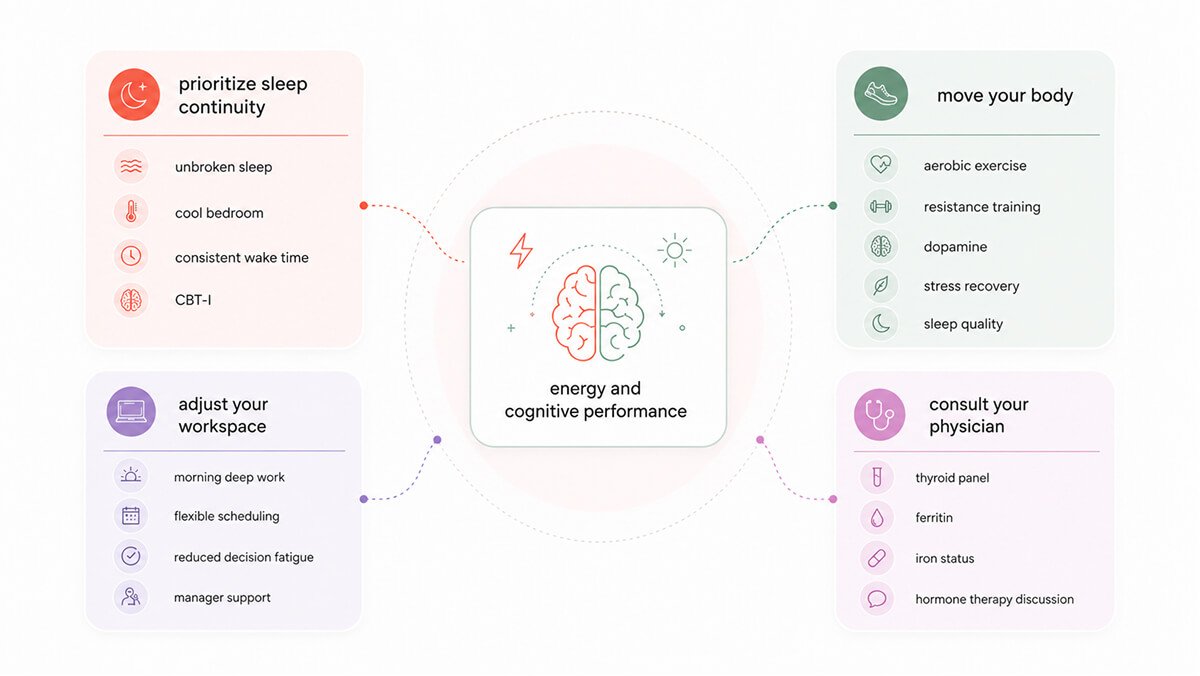
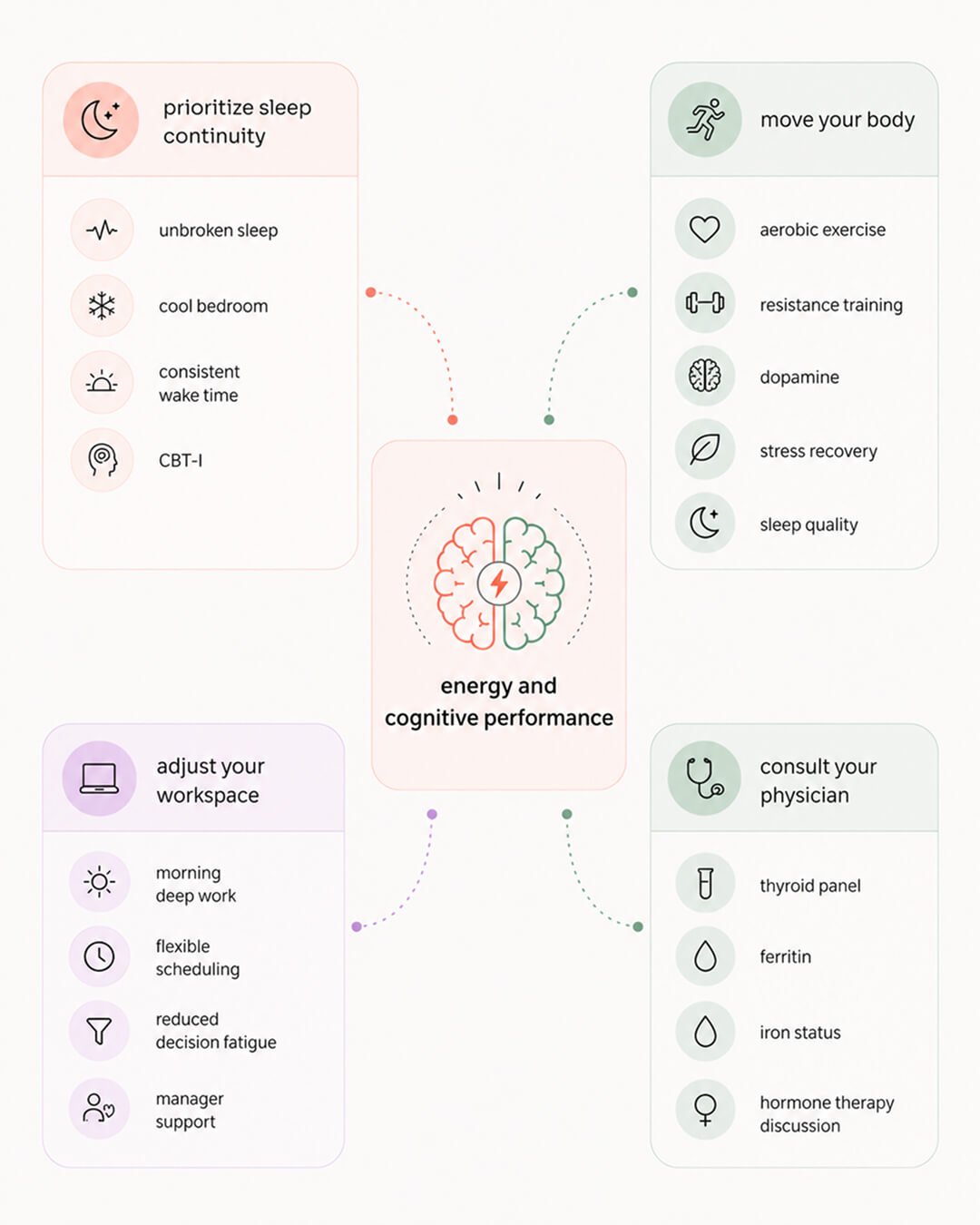
If you want to improve your energy, start with sleep. It is the recovery window for your alertness system, your prefrontal cortex, and your stress recovery. Unfortunately, it is also the most disrupted part of the transition. Hot flashes, night sweats, and hormonal insomnia fragment the very nights your brain needs for repair.
Focusing on sleep continuity (unbroken rest) is the move that helps everything else. Keeping a consistent wake time, ensuring your bedroom is cool, and using proven tools like cognitive behavioral therapy for insomnia can help your brain get the maintenance it needs to fight off menopause fatigue.
Exercise is the second-highest leverage tool at your disposal. A combination of aerobic and resistance training addresses dopamine levels, stress recovery, and sleep quality all at once. While the full neurological benefits build over several months, most women see improvements in their mood and energy within just a few weeks. Regular movement is one of the most effective ways to stop feeling exhausted by the end of the workday.
Where you have control, restructure your day to match your biology. Research shows that flexible scheduling, manager awareness, and structured exercise programs significantly improve productivity and reduce the burden of symptoms.20 This is a shared responsibility; it is not up to the woman alone to navigate these changes. Employers and managers play a vital role in ensuring high-performing talent isn’t lost during this transition.
A targeted medical conversation is essential. When you speak with a doctor, ask for these specific checks:
During perimenopause, four critical brain systems: alertness, executive function, stress recovery, and motivation, begin to function with less estrogen support. Each of these networks has its own biological requirements and a direct impact on your professional performance. While most public health advice for perimenopause fatigue focuses on a single symptom, the real solution lies in understanding which of these four systems is running low and addressing them strategically.
Most importantly, it is time to stop attributing these changes to a loss of ambition or character. Feeling exhausted doesn’t mean you are any less capable than you were five years ago, it simply means your brain now requires different infrastructure to perform the same high-level work.
Dr. Jura Lasas
1.
Faubion S.S. et al. Impact of Menopause Symptoms on Women in the Workplace (2023). https://doi.org/10.1016/j.mayocp.2023.02.025
2.
The Menopause Society. Menopause and the workplace: consensus recommendations from The Menopause Society (2024). https://doi.org/10.1097/GME.0000000000002415
3.
Hudson A.N. et al. Sleep deprivation, vigilant attention, and brain function: a review (2019). https://doi.org/10.1038/s41386-019-0432-6
4.
Almey A. et al. Estrogen receptors in the central nervous system and their implication for dopamine-dependent cognition in females (2015). https://doi.org/10.1016/j.yhbeh.2015.06.010
5.
Sima J. et al. Restoration of locus coeruleus noradrenergic transmission during sleep (2024). https://doi.org/10.1101/2024.07.03.601820
6.
Joffe H. et al. A gonadotropin-releasing hormone agonist model demonstrates that nocturnal hot flashes interrupt objective sleep (2013). https://doi.org/10.5665/sleep.3244
7.
Bjerrum L.B. et al. Acute effects of light during daytime on central aspects of attention and affect: A systematic review (2024). https://doi.org/10.1016/j.biopsycho.2024.108845
8.
Irwin C. et al. Effects of acute caffeine consumption following sleep loss on cognitive, physical, occupational and driving performance: a systematic review and meta-analysis (2019). https://doi.org/10.1016/j.neubiorev.2019.12.008
9.
Berent-Spillson A. et al. Hormonal environment affects cognition independent of age during the menopause transition (2012). https://doi.org/10.1210/jc.2012-1365
10.
Konishi K. et al. Impact of adrenal hormones, reproductive aging, and major depression on memory circuitry decline in early midlife (2019). https://doi.org/10.1016/j.brainres.2019.146303
11.
Stefaniak M. et al. Progesterone and Its Metabolites Play a Beneficial Role in Affect Regulation in the Female Brain (2023). https://doi.org/10.3390/ph16040520
12.
Schweizer-Schubert S. et al. Steroid Hormone Sensitivity in Reproductive Mood Disorders: On the Role of the GABA-A Receptor Complex and Stress During Hormonal Transitions (2021). https://doi.org/10.3389/fmed.2020.479646
13.
Lozza-Fiacco S. et al. Baseline anxiety-sensitivity to estradiol fluctuations predicts anxiety symptom response to transdermal estradiol treatment in perimenopausal women: a randomized clinical trial (2022). https://doi.org/10.1016/j.psyneuen.2022.105851
14.
de Zambotti M. et al. Acute stress alters autonomic modulation during sleep in women approaching menopause (2016). https://doi.org/10.1016/j.psyneuen.2015.12.017
15.
Caplin A. et al. The effects of exercise intensity on the cortisol response to a subsequent acute psychosocial stressor (2021). https://doi.org/10.1016/j.psyneuen.2021.105336
16.
Blaser B.L. et al. The effect of a single-session heart rate variability biofeedback on attentional control: does stress matter? (2023). https://doi.org/10.3389/fpsyg.2023.1292983
17.
Diekhof E.K. et al. Avoidance Learning Across the Menstrual Cycle: A Conceptual Replication (2020). https://doi.org/10.3389/fendo.2020.00231
18.
Diekhof E.K. et al. The Straw That Broke the Camel’s Back: Natural Variations in 17β-Estradiol and COMT-Val158Met Genotype Interact in the Modulation of Model-Free and Model-Based Control (2021). https://doi.org/10.3389/fnbeh.2021.658769
19.
Jonasson L.S. et al. Higher striatal D2-receptor availability in aerobically fit older adults but non-selective intervention effects after aerobic versus resistance training (2019). https://doi.org/10.1016/j.neuroimage.2019.116044
20.
Rodrigo C.H. et al. Effectiveness of workplace-based interventions to promote wellbeing among menopausal women: a systematic review (2023). https://doi.org/10.1177/20533691231177414
21.
Zhang G.Q. et al. Menopausal hormone therapy and women’s health: an umbrella review (2021). https://doi.org/10.1371/journal.pmed.1003731

Mood & Energy Solutions

Fatigue Causes & Types
Fatigue Causes & Types

Workplace Strategies

Menopause at Work

Brain Fog at Work

Brain Fog at Work

Is This Perimenopause?

Is This Perimenopause?

Nutrition & Supplements

Workplace Strategies

Menopause Science

Menopause Science

Brain Fog Solutions

We use cookies and similar technologies to ensure the proper functioning of our website, personalize content, provide social media features, and analyze traffic. By clicking “I Agree”, you consent to the use of these technologies.
No results