18 June 2025
How to Fix Menopause Brain Fog: Evidence-Based Treatments That Actually Work

Reading time 9 min

Reading time 9 min
Jane is 49 and runs a department of forty people. She drove halfway to work before realizing she was still wearing her slippers. The week before, she sat in a meeting with a client she had known for six years and could not retrieve his name. What Jane is experiencing has a name and a mechanism.
“Brain fog” is a colloquial term, not a clinical diagnosis. Brain fog is rooted in how the brain processes information. The cognitive functions most affected during the menopause transition are verbal learning, verbal memory, processing speed, attention, and working memory.1 In plain terms: the word you want, the speed at which you find it, and the ability to hold three things in mind at once while doing a fourth.
Women often ask how to fix menopause brain fog and what menopause brain fog treatments actually work. The honest answer is that some of the standard advice follows the science, and some does not.


Brain fog in perimenopause is caused by five mechanisms layered on top of each other. The hippocampus and prefrontal cortex, the brain regions running memory and executive function, are densely populated with estrogen receptors and depend on estrogen to keep neuronal connections strong and firing efficiently.2,3 When estrogen drops, those connections weaken, communication between cells slows, and human imaging studies show regional changes in brain activity that track with cognitive performance.4 At the same time, sleep architecture fragments due to hot flashes and night sweats, cutting short the deep stages where the brain consolidates memory and clears metabolic waste.5 Cortisol patterns change as estrogen falls, keeping the brain in a low-grade alert state that is incompatible with focus.6
The cellular machinery underneath all of this is also under strain. Neurons become more resistant to insulin in midlife, which is amplified by estrogen withdrawal, and they struggle to extract the glucose they need to function.7 Microglia, the brain’s resident immune cells, shift toward chronic activation and release inflammatory signals that interfere with communication between neurons.8 Mitochondria, the power plants inside brain cells, lose efficiency when estrogen drops, particularly in the hippocampus. And the gut microbiome, which produces neurotransmitter precursors and modulates the immune signals reaching the brain, is itself disrupted during the menopause transition through a feedback loop with estrogen.9 None of these mechanisms operate alone. Brain fog is what their combined effect feels like from the inside.
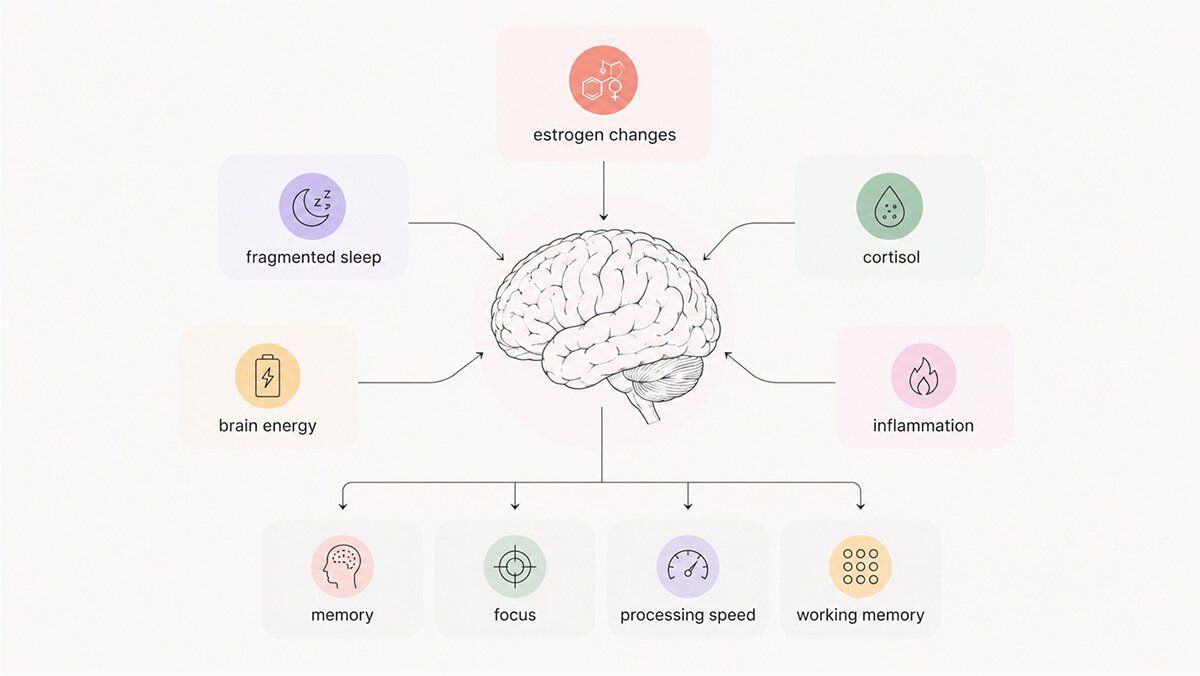
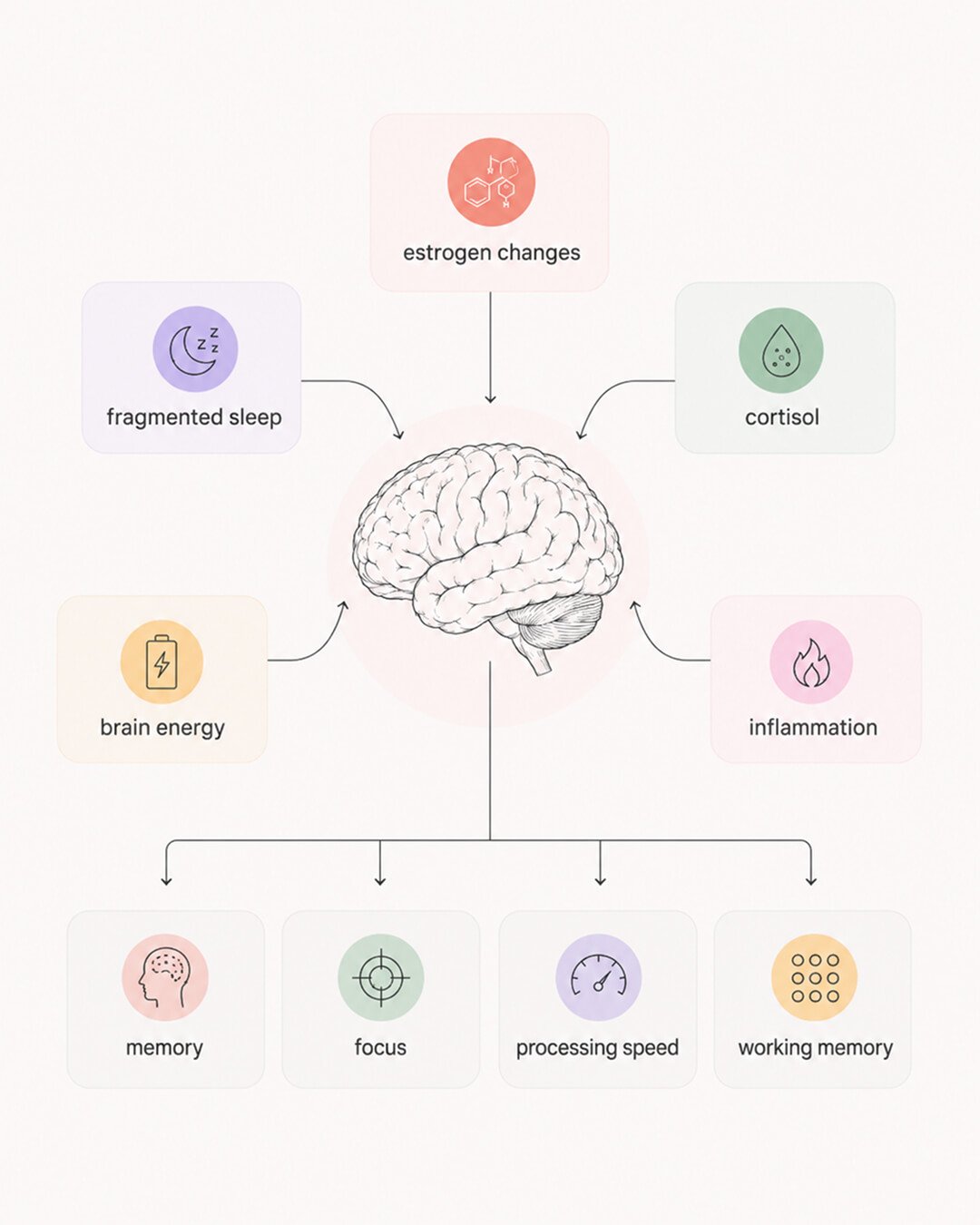
Cognitive symptoms in perimenopause arrive at the worst possible career moment. Most women in this transition are running departments, leading teams, billing at the highest rate they ever have. Women in the highest quartile of menopause symptom severity are nearly 16 times more likely to report adverse work outcomes than women in the lowest quartile, with an estimated $1.8 billion annual productivity loss in the U.S. workforce.10 In separate surveys, 65% of menopausal women reported reduced work performance, 51% worried about being seen as less capable, and symptom severity directly predicted intentions to leave the job.11
Hormone replacement therapy (HRT) is the most studied intervention for general menopause symptoms, but HRT does not have strong support for cognitive symptoms. The North American Menopause Society does not currently recommend hormone therapy as menopause brain fog treatment.1 Estrogen supports cognition, but replacing it does not produce consistent enough cognitive benefit to justify it as a cognitive treatment.
That said, many women on hormone therapy for vasomotor symptoms or sleep disruption do report cognitive improvements as a downstream effect, often because their sleep recovers. The decision to use hormone therapy is between you and your doctor.
While not a primary menopause brain fog treatment, HRT may support women looking for what helps menopause brain fog indirectly through better sleep.
Exercise has some of the strongest evidence for how to fix menopause brain fog naturally. Aerobic exercise has been shown in randomized trials to help think faster in postmenopausal women over a six-month intervention.12 A combined exercise plus dietary intervention in obese postmenopausal women improved executive function, memory, BDNF (a key brain growth factor), insulin sensitivity, and body composition compared to controls.13
The mechanism is not mysterious. Exercise improves blood flow to the brain. It increases BDNF, which supports the same neuronal connections estrogen used to support more abundantly. Excercise improves insulin sensitivity in the brain. It also supports sleep architecture and modulates the inflammatory signals that contribute to brain fog. It does all of this whether you exercise in the morning or the evening, alone or in a class, indoors or outside.
For menopause brain fog relief, most studies agree on 150 minutes of moderate aerobic activity per week, plus two strength sessions. The strength piece matters because muscle is a metabolic and endocrine organ, and you are losing it faster now. “Menopause brain fog exercise” is not a category of fancy workouts. It is whatever you will actually do consistently.
If you’re searching for what helps menopause brain fog, sleep is one of the most effective and immediate interventions.
You cannot think your way past sleep deprivation. The brain consolidates memory during sleep, particularly during slow-wave sleep, which is the stage most disrupted by night sweats and the cortisol shifts that accompany the menopause transition.
The most studied non-pharmacological treatment for sleep is cognitive behavioral therapy for insomnia, often called CBT-I. In a randomized trial of postmenopausal women with chronic insomnia, CBT-I improved fatigue, daytime energy, work productivity, and quality of life, which held at six months. CBT-I is more effective than sleep hygiene education and more durable than sleep medication.14
If structured CBT-I is not available, the lower-tier interventions are still worth doing. Cool the bedroom. Manage the symptoms that wake you, including hot flashes and night sweats. Hold a consistent wake time, including on weekends. Limit alcohol, which fragments the second half of the night particularly badly during perimenopause. None of this is glamorous, but all of it works to help you fix brain fog.
The diet with the most consistent cognitive evidence in women is Mediterranean-style: rich in vegetables, fish, olive oil, nuts, whole grains, and legumes, low in processed foods and added sugar. The mechanism overlaps with anti-inflammatory effects, omega-3 support for neuronal membranes, glucose stability, and support for the gut microbiome.15
This dietary pattern is often recommended among natural remedies for menopause brain fog due to its anti-inflammatory and metabolic benefits.
A meta-analysis across 30 randomized trials of psychosocial interventions during the menopause transition found significant improvements in cognition, depression, anxiety, and quality of life from cognitive behavioral therapy and mindfulness-based interventions.16 In one study of 208 perimenopausal women, those who scored higher on mindfulness were about half as likely to report memory retrieval problems and roughly two-thirds less likely to report attention problems.17
These interventions help most with the subjective experience of brain fog and the stress reactivity that amplifies it. They do not always produce changes on objective neuropsychological tests. The way you experience your own cognition affects how you function. A woman who has tools for managing the cognitive load she carries is not the same woman six months later who does not.
These approaches are frequently overlooked but are effective natural remedies for menopause brain fog, especially when stress is a trigger.
Brain training apps are a mixed bag. Most of them improve performance on the specific tasks they train, with limited transfer to daily cognitive function. The exception is cognitive training that mirrors real-world demand: language learning, instrument practice, complex strategy games, and demanding work itself. The research on cognitive reserve is consistent. The brain that is regularly asked to do hard things holds up better.
If you are reading this and running a department, you are already doing this. The interventions worth adding are sleep, exercise, and stress management, not another app.
These strategies complement other menopause brain fog treatments by strengthening long-term cognitive resilience.
If you’re wondering how to fix menopause brain fog in a particular moment, I have designed this protocol for real-time recovery.
Use this protocol for the meeting where you feel the fog roll in and need to come back online without anyone noticing. Three steps, two to three minutes, all of it discreet enough to do while someone else is talking.
The goal is to drop sympathetic activation enough for the prefrontal cortex to come back online. Inhale through the nose for four seconds. Exhale through slightly pursed lips for six to eight seconds. Repeat for six to eight cycles while keeping your eyes on the speaker or your notes. It looks like attentive listening. The slightly longer exhale increases parasympathetic tone, which reduces stress reactivity and frees up attention and working memory.18
Brief muscle activation increases cerebral blood flow without showing on the outside. Pick one. Press your toes into the floor for three seconds, release, alternate feet. Or squeeze both calves for five seconds and release. Or run your thumb to each fingertip in sequence (1, 2, 3, 4, 3, 2, 1) on your lap. Small voluntary muscle activation supports alertness and helps counteract the attention drift that comes with perimenopausal fog. You can stack this with Step 1, breathing while you pump.19
Give the foggy brain a structure to lean on so you can follow the meeting and speak clearly even if recall feels impaired. If you have a notebook or laptop open, draw three columns: “What they said,” “So what,” “My line.” For each point, capture two to five words in each column, no more. “Q3 revenue off target. Need cost options. From ops, the risk is X and we need Y.” When it is your turn to speak, glance at “My line” and start talking. Externalizing working memory like this is the right adaptation for menopause brain fog. It takes load off the prefrontal cortex, improves recall, and protects how clearly you sound in the room.20
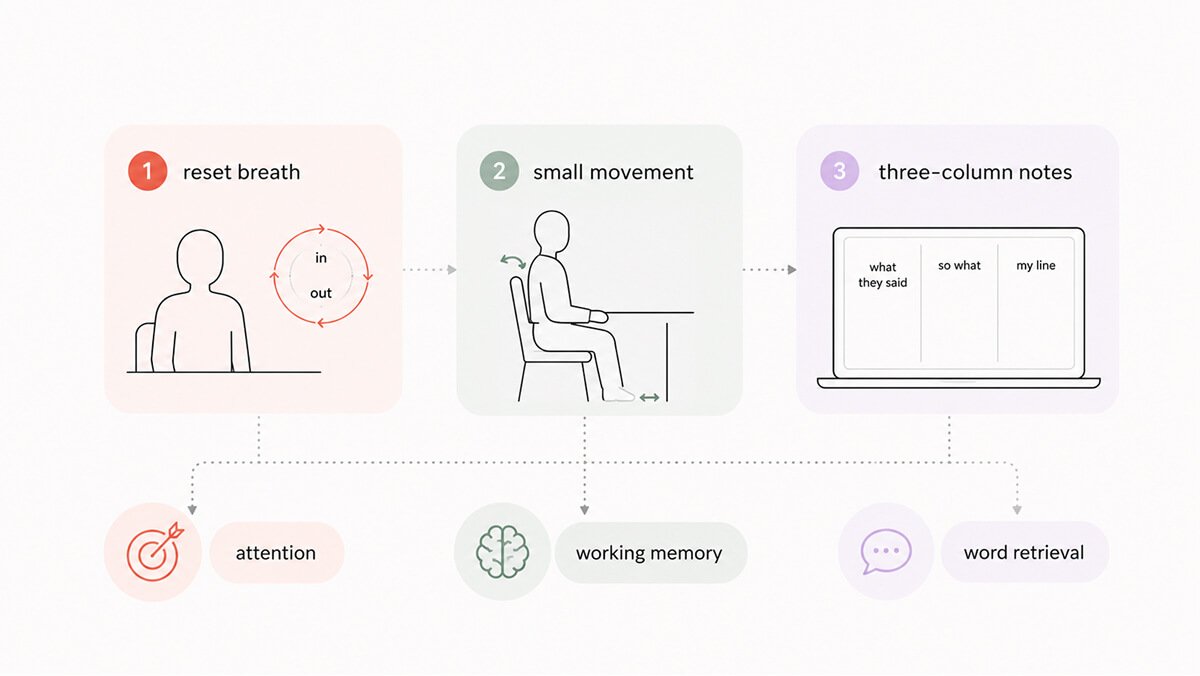
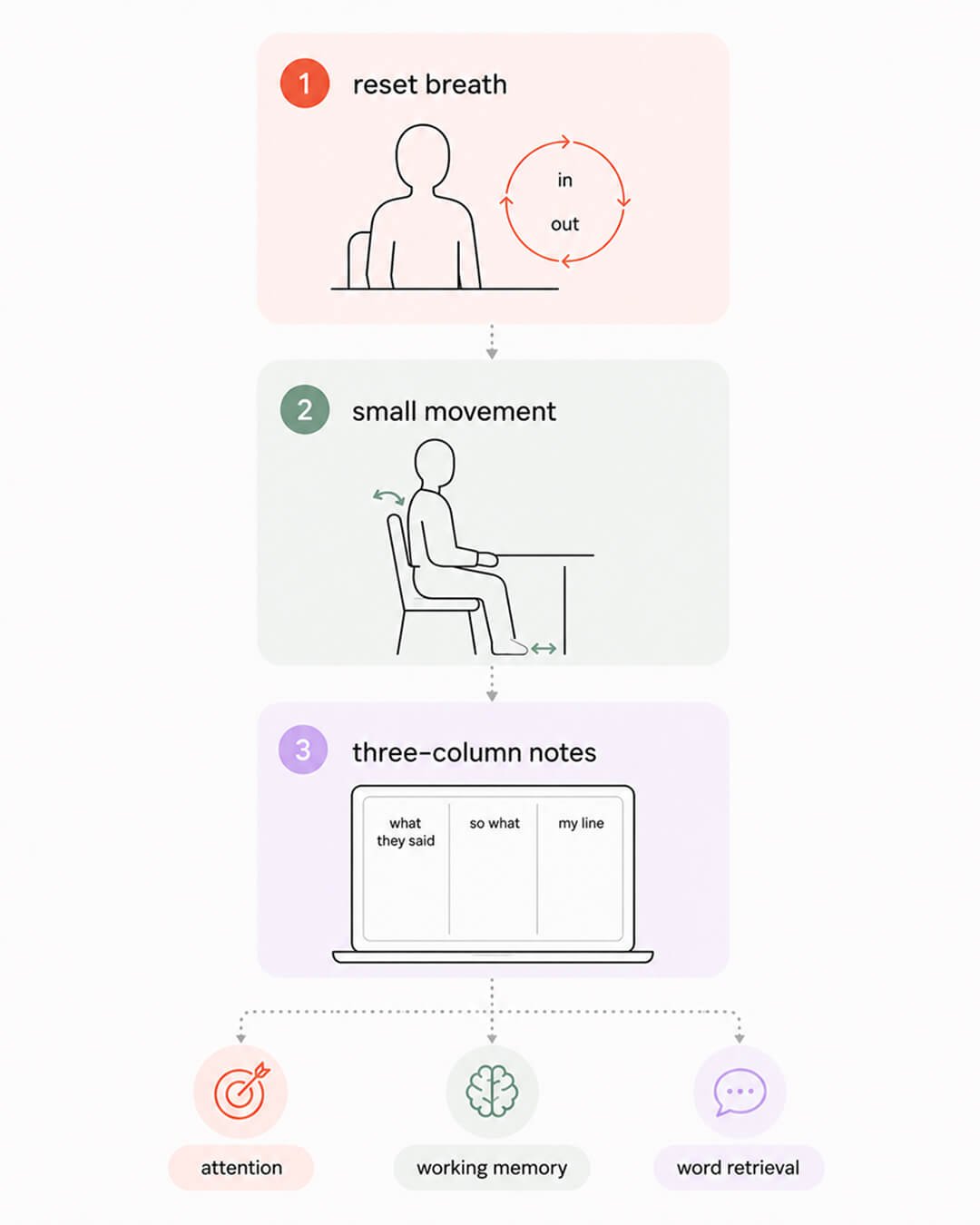
Use the above protocol when you notice the fog, you are blanking or losing the thread. Reset the breath for sixty to ninety seconds while you keep listening. Add the foot pumps or calf squeezes for the next sixty seconds, breathing the whole time. Then set up the three-column notes while still breathing. The reset takes two to three minutes and most of it is invisible.
How to fix menopause brain fog and what helps menopause brain fog long-term are some of the most common questions women ask during perimenopause. The answer is unglamorous. Sleep, exercise, real whole food, and fewer demands on your working memory than your old self could carry.
The protocol to fix menopause brain fog I shared with you is one example of how I think about brain fog. Each technique has its own mechanism behind it to make sure it works. Brain fog costs women their confidence and their careers, and almost none of us were told the biology behind it. It’s not dementia and there are concrete steps you can take to thrive during the period of your brain reorganization, also known as “perimenopause!”
Dr. Jūra Lašas
1.
Metcalf, C. et al. Cognitive Problems in Perimenopause: A Review of Recent Evidence. Current Psychiatry Reports (2023). https://doi.org/10.1007/s11920-023-01447-3
2.
Wickelgren, I. Estrogen Stakes Claim to Cognition. Science (1997) https://doi.org/10.1126/science.276.5313.675
3.
Maioli, S. et al. Estrogen receptors and the aging brain. Essays in Biochemistry (2021). https://doi.org/10.1042/EBC20200162
4.
He, L. et al. Altered Spontaneous Brain Activity in Women During Menopause Transition and Its Association With Cognitive Function and Serum Estradiol Level. Frontiers in Endocrinology (2021). https://doi.org/10.3389/fendo.2021.652512
5.
Maki, P. et al. Menopause and Brain Health: Hormonal Changes Are Only Part of the Story. Frontiers in Neurology (2020). https://doi.org/10.3389/fneur.2020.562275
6.
Au, A. et al. Estrogens, inflammation and cognition. Frontiers in Neuroendocrinology (2016). https://doi.org/10.1016/j.yfrne.2016.01.002
7.
Duarte, A. et al. Brain insulin signalling, glucose metabolism and females’ reproductive aging: A dangerous triad in Alzheimer’s disease. Neuropharmacology (2018). https://doi.org/10.1016/j.neuropharm.2018.01.044
8.
McCarthy, M. et al. The peri-menopause in a woman’s life: a systemic inflammatory phase that enables later neurodegenerative disease. Journal of Neuroinflammation (2020). https://doi.org/10.1186/s12974-020-01998-9
9.
Baker, J. et al. Estrogen-gut microbiome axis: Physiological and clinical implications. Maturitas (2017). https://doi.org/10.1016/j.maturitas.2017.06.025
10.
Faubion, S. et al. Impact of Menopause Symptoms on Women in the Workplace. Mayo Clinic Proceedings (2023). https://doi.org/10.1016/j.mayocp.2023.02.025
11.
O’Neill, M. et al. Impact of menopausal symptoms on work and careers: a cross-sectional study. Occupational Medicine (2023). https://doi.org/10.1093/occmed/kqad078
12.
Bender, C. et al. Effects of aerobic exercise on neurocognitive function in postmenopausal women receiving endocrine therapy for breast cancer: The Exercise Program in Cancer and Cognition randomized controlled trial. Psycho-Oncology (2024). https://doi.org/10.1002/pon.6298
13.
Keawtep, P. et al. Effects of combined dietary intervention and physical-cognitive exercise on cognitive function and cardiometabolic health of postmenopausal women with obesity: a randomized controlled trial. International Journal of Behavioral Nutrition and Physical Activity (2024). https://doi.org/10.1186/s12966-024-01580-z
14.
Kalmbach, D. et al. Improving Daytime Functioning, Work Performance, and Quality of Life in Postmenopausal Women With Insomnia: Comparing Cognitive Behavioral Therapy for Insomnia, Sleep Restriction Therapy, and Sleep Hygiene Education. Journal of Clinical Sleep Medicine (2019). https://doi.org/10.5664/jcsm.7882
15.
Rodríguez-Espinosa, N. et al. Adherence to the Mediterranean diet and waist-to-hip ratio in middle-aged postmenopausal women are the main factors associated with semantic verbal fluency 12 years later. Frontiers in Nutrition (2023). https://doi.org/10.3389/fnut.2023.1106629
16.
Spector, A. et al. The effectiveness of psychosocial interventions on non-physiological symptoms of menopause: A systematic review and meta-analysis. Journal of Affective Disorders (2024). https://doi.org/10.1016/j.jad.2024.02.048
17.
Zhu, C. et al. Factors associated with subjective cognitive symptoms during the menopause transition. Menopause (2025). https://doi.org/10.1097/gme.0000000000002651
18.
Masmoudi, K. et al. A single session of slow-paced breathing improved cognitive functions and postural control among middle-aged women: a randomized single blinded controlled trial. Menopause (2025). https://doi.org/10.1097/gme.0000000000002470
19.
Fischetti, F. et al. Ten-Minute Physical Activity Breaks Improve Attention and Executive Functions in Healthcare Workers. J Funct Morphol Kinesiol. (2024). https://doi.org/10.3390/jfmk9020102
20.
Belland, B.R. et al. A Framework for Designing Scaffolds That Improve Motivation and Cognition. Educ Psychol. (2013). https://doi.org/10.1080/00461520.2013.838920

Mood & Energy Solutions

Fatigue Causes & Types

Fatigue Causes & Types

Workplace Strategies

Menopause at Work

Brain Fog at Work

Brain Fog at Work

Is This Perimenopause?

Is This Perimenopause?

Nutrition & Supplements

Workplace Strategies

Menopause Science

Menopause Science

Brain Fog Solutions

We use cookies and similar technologies to ensure the proper functioning of our website, personalize content, provide social media features, and analyze traffic. By clicking “I Agree”, you consent to the use of these technologies.
No results